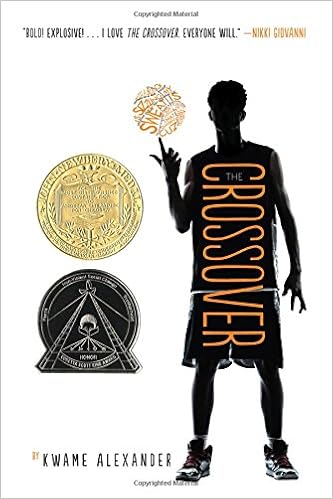
The Crossover Written by Kwame Alexander Poetry Verse Novel Fiction
Awards
2015 John Newberry Medal Coretta Scott King Award Honor NCTE Charlotte Huck Award Honor Lee Bennett Hopkins Poetry Award Passaic Poetry Prize
About the Author
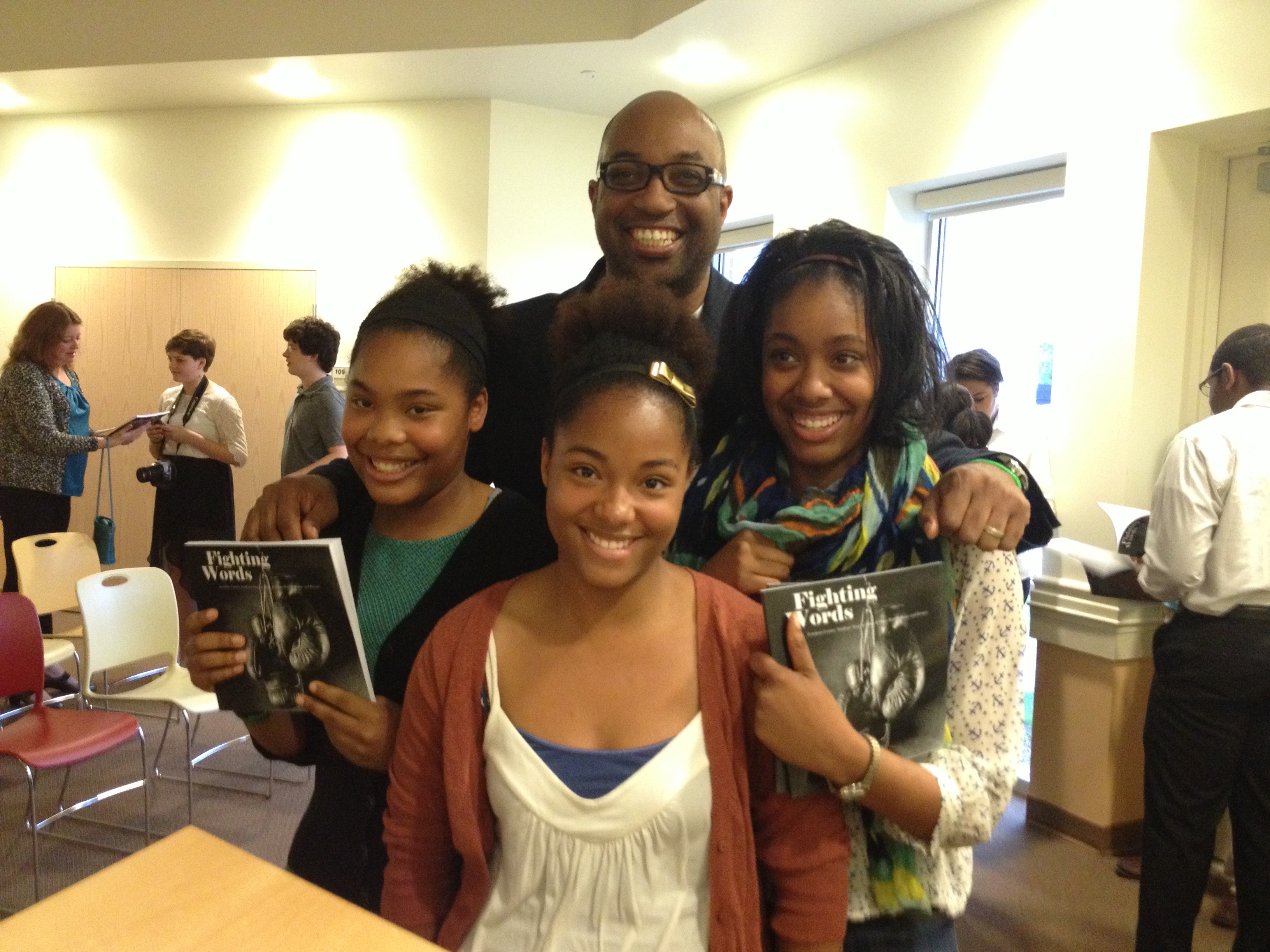
Kwame and his kids!
Kwame Alexander is an inspirational, award-winning poet, educator, and New York Times Bestselling author of 32 books. He was born in Manhattan, NY. His parents are writers and most everyone in his family is an artist of some kind.
Kwame’s belief in the power of poetry and literature to inspire, engage, and empower young people is the guiding force behind the #AllBooksForAllKids initiative he created in partnership with Follett.”
kwamealexander.com/about/me/
Book Summary
The Crossover is a story written entirely in poetry verse and follows the lives of twins, Josh “Filthy McNasty” Bell and Jordan “J.B.” Bell. Josh and J.B. are amazing basketball players heading towards championships. Their dad was previously a famous basketball player in Italy. It is a story of basketball, school, family, first crushes, and loss. When a new girl starts at their school, Josh must deal with the loss of his best friend and twin brother to a girl. Josh and Jordan must navigate more than just basketball as life throws them many new changes and challenges.
Writing Elements
It is great that this is a book of poetry, a book of basketball poetry. This book is one that would likely spark the interest in the reading of poetry in young boys or anyone not usually interested in poetry. The musical and rap-like poetry verses will captivate and engage readers as they follow Josh “Filthy McNasty”‘s life. Tunnell et al. (2016) mention that poetry is often glanced over in classrooms due to a teacher’s lack of appreciation or comfort in teaching poetry. Children also learn to dislike poetry because of this and when teachers make “all the decisions about poetry and its use in the classroom” (p 95). If students were given the option to choose poetry of their own interests, they would likely grow to like and appreciate it. Students would likely read The Crossover and grow to love poetry and all the possibilities it brings for strong, emotional, interesting, and fun writing.
Kwame Alexander utilizes many different poetry forms in The Crossover. What was most noticeable and memorable was his playfulness with words and how for some poems they would be climbing all around the page, with some bigger or smaller text, to really accentuate and bring to life the story being told.
A lot of the poems are in narrative form. They tell stories that happen to Josh and Jordan both at school and at home. Most of the poems are also in lyricform, as Kwame’s words flow with rhythms and beats. Kwame also utilizes mostly free verse since most, if not all, of the poems are unrhymed.
I really enjoyed his use of “definition” poems such as the one titled, hy-per-ten-sion, where the reader finds out the his grandfather died of the same thing his father has. He uses this form of poetry throughout the novel, which is a very unique and interesting way to present information and convey how Josh is feeling about certain things happening in his life.
Critical Literacy
The Crossover provides a lens into the life of a pre-teen black boy. Having a black protagonist is still under-represented in literature today. Readers walk in Josh’s shoes as he and his dad are running late to a basketball game and experience the real fear of being pulled over while black. Readers get to experience his mother’s fear of him being stereotypically labeled as violent after his outburst towards his twin brother. “Boys with no discipline end up in prison.” (p 136). Students may wonder why his mother is so worried, it was just a mistake? Is it because he’s a boy? Is it because he is a black boy? Are these fears and worries that I have to deal with? What is it like to be a black boy in America today?
Readers get to experience what it is like to be a twin boy, both of which are amazing basketball players. They can experience the hurt one twin feels as the other experiences their first girlfriend and starts spending less time with the one person he’s spent his whole life with. Readers can put themselves in the mother’s shoes as she worries about her husband’s health, her children’s education, and her family’s future. They can also put themselves in the father’s shoes as he lives a life after fame vicariously living through his sons, and as combats health issues alongside a fear of hospitals and doctors since his own father’s death.
2012 Finalist for the National Book Critics Circle Award 2016 Eureka! Honor Awards from the California Reading Association 2017 Honor Book Award for the Américas Award for Children’s and Young Adult Literature 2017 International Literacy Association Children’s Book Award International Latino Book Award 1st Place
About the Author
Reyna Grande is an award-winning author and inspirational speaker who was born in Mexico. Reyna came to America at 10 years old as an undocumented immigrant. She later became the first in her family to graduate college. She is and avid promotes Latino literature. She currently teaches creative writing at UCLA.
Book Summary
The Distance Between Us is the true story of Reyna Grande’s life in a poor town in Mexico and her and her family’s journey as they navigate life, poverty, immigration to the U.S., alcoholism and abuse, and simply growing up. Reyna’s parents leave Mexico to find work so they can build a better life for their children back in Mexico. Reyna’s father left when she was only 2 and his head was always filled with dreams, dreams of a better life, a safe house for his family, and opportunities for his children. Reyna and her siblings have to deal with the fact that if their parents are to accomplish their dreams, they have to leave them with grandparents, in poverty, while they cross the border to work in El Otro Lado, “The Other Side”.
Multicultural Elements
Multicultural books are necessary for the representation of the experiences of all humans. “Literature can be one of the most powerful tools for combating the ignorance that breeds xenophobic and judgmental behaviors” (Tunnell et al., 2016, p. 202). Reyna’s memoir is an honest, credible, interesting, and believable story of her actual experiences with poverty, abuse, immigration, and adapting to a brand new culture and environment. Readers can experience the challenges that undocumented immigrants face when moving to a new country; learning the language, adapting to a different culture, and lack of supports like health insurance and family. They can learn that they face racism and ridicule for not “fitting in” or speaking the language. They can learn how it feels when you’re only choice to provide for your family is to leave them behind or risk their lives to take them with you. They can learn how it feels to long to be in two place, two cultures at once.
Was my uncle right? Was it better to be poor but together? Or was it better to try to find a better life, even if it meant breaking up your family?”
p 268
Books serve as a mirror, but also a window. Students who can see themselves in the experiences and lives of Reyna and her family will be able to feel like their experiences are validated and that they are not alone. Students who cannot relate to Reyna’s experiences will be able to use this book as a window into the life and culture of Reyna and her family, as well as many other immigrant people who share a similar story. Reyna’s experiences are not always positive, but they are honest. Students can become empathetic towards those who have experiences just like the ones in the book, whether it be with immigration, poverty, alcoholism, abuse, or abandonment. They can also be proud of Reyna as she follows her dreams, overcomes adversity, and accomplishes her goals.
Critical Literacy
Since we follow Reyna from childhood in Mexico all the way until she graduates college in America, we get to see life from a view different perspectives of hers. When she is a child in Mexico, living with her grandmother, she longs for her mother and father to return so that they can be a family again, and so they can get away from the abuse of her father’s mother. At this time, she can’t quite understand why her parents had to leave them. “Me ama mi mamá? ‘Does my mama love me?’ If so, why is she so far away?” (p 60). But later, after she is much older and has lived in America for a while, she finally gets to visit her family in Mexico. She finds out then that the people in the town where she is from have begun to view her differently, not that she lives in El Otro Lado and is more or less out of poverty in their eyes. “I was no longer considered Mexican enough. To the people there, who’d seen me grow up, I was no longer one of them” (p 270). Readers can discuss why this might happen and how Reyna felt to be disowned by her the people of her home town. Mago shows the reader a different perspective in that she viewed the U.S. as her new home and appeared to actually be trying to erase her connections to her old home. Why would Mago do this? Is she ashamed of Iguala, of her poor background? “Even in her speech, she was trying to erase Mexico completely” (p 272).
Another perspective that shines through is that of her father and how his upbringing and immigration experiences have affected the way he raised his children. Mila would remind the children after he would abuse them that he did not know any better since that was how he was raised. Reyna would explain that it was tiring to hear those excuses and her justifying his behavior. This is very relatable to those that have experienced abuse. Her siblings got out and started families as fast as they could, not trying to pursue the dreams their father tried to instill in them. On the other side of the coin was Reyna. Despite it all, she believed in those dreams and kept fighting for them. This is a very positive and hopeful light to which readers can view Reyna’s experiences. She won her first writing competition, met her hero, Diana, and was the first in her family to ever graduate college.
When my father beat me and insulted me when he was drunk, I’d hold on to the dreams he had given me.”
p 251
Another perspective that struck me, was of Reyna as a new student that only spoke Spanish and the educational inequities she experienced because of this. She was placed in a “regular” classroom and then segregated to a table with the other Spanish speaking students. Socially this excluded them, as classmates would view them as other and because the school and the teachers weren’t trying to include them, why would they? Reyna mentions that the she has an “addiction to reading” (p234), yet it wasn’t until she meets Diana in community college that she gets to experience Latinx literature! If that isn’t a call for more representation of diverse cultures and backgrounds, then I don’t know what is.
For the first time since I’d become an avid reader, I found myself reading about characters who lived in a world like my own, characters with the same color skin as mine. With the same heartaches and dreams.”
p 300
Readers might not have been aware of the struggles of those in poverty, of those leaving everything behind to find opportunities in the U.S., of being an undocumented person just trying to live. Hopefully after reading this book, students would be drawn to take action for social justice against the inequities faced by undocumented immigrants. Most are fleeing circumstances worse than we can every imagine. Reader can learn to question why we have these imaginary borders dividing humans from humans and why because of these invisible lines, people are dying, are being put in cages, and are being taken away from their parents.
‘This is where Mexico ends and the U.S. begins,’ the coyote said. But no matter how hard I looked, I couldn’t tell how he knew that. It all looked the same to me. ‘The line is invisible.’ he said, as if reading my thoughts.
Reyna was 10 years old when she risked her life to come to the US – p 141
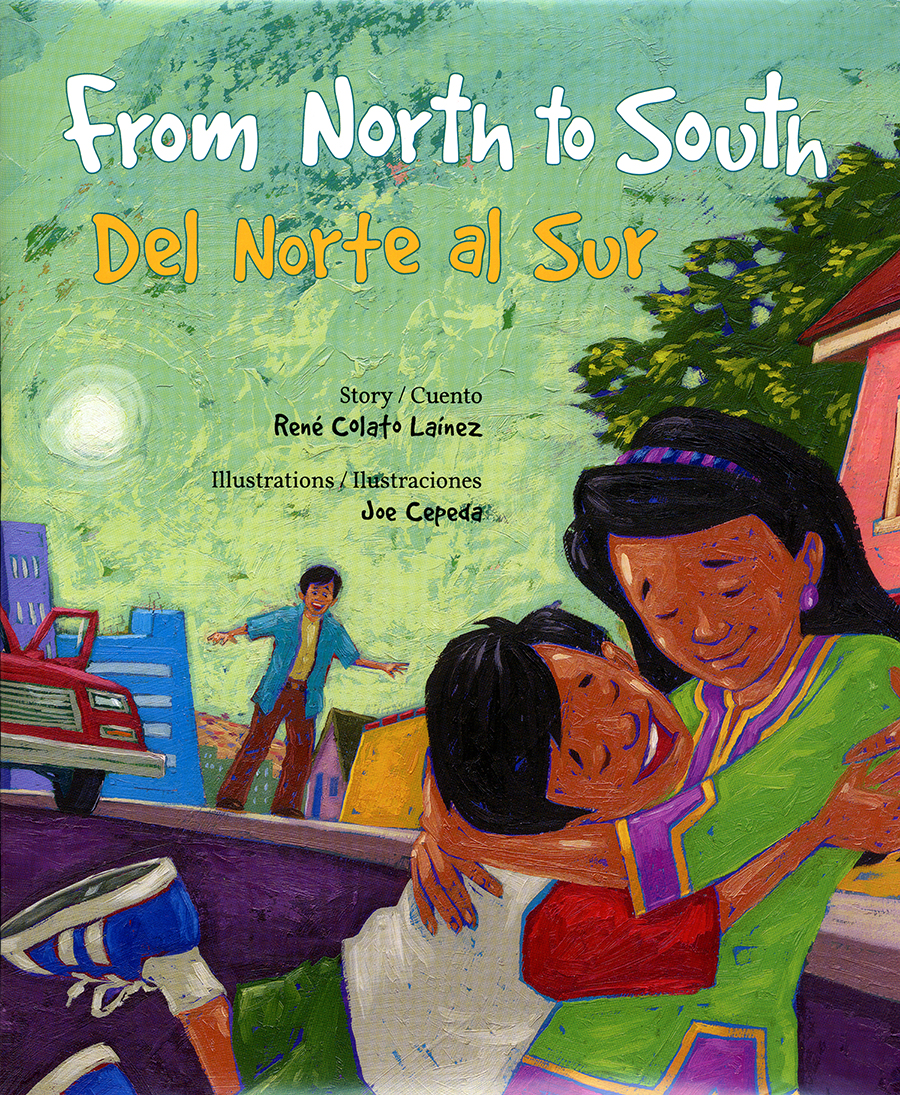
Written by Rene Colato Lainez Illustrated by Joe Cepeda Bilingual English/Spanish Picture Book Contemporary Realistic Fiction Multicultural
Awards
International Latino Book Award Best Bilingual Children’s Book Americas Award Commended Title California Book Award Finalist Tejas Star Book Award Finalist Junior Library Guild Selection
About the Author
René Colato Laínez
My goal as a writer is to produce good multicultural children’s literature; stories where minority children are portrayed in a positive way, where they can see themselves as heroes, and where they can dream and have hopes for the future. I want to write authentic stories of Latin American children living in the States.”
René Colato Laínez is an Salvadoran children’s book author and elementary school teacher where his student’s know him as the “teacher full of stories”. He was inspired by his mother’s famous writer uncle to become an escritor (writer) himself. He draws inspiration for his work from his own immigration experiences from El Salvador to Los Angeles as well as those experiences of his elementary students.
Family separation is a traumatic experience. “
From north to south – introduction
About the Illustrator
Joe Cepeda is an award winning children’s book illustrator and author. He has one the Pura Belpré Honor Award fo his illustrations. He was born and raised in Los Angeles and received his BFA in Illustration from California State University, Long Beach.
Preferring grace over style, message over technique, and story over extravagance, Joe seeks to create work with integrity and authenticity at its core.”
The author is donation a portion of his royalties to El Centro Madre Assunta, the refuge in Tijuana for immigrant women and children who have been recently deported from the U.S. and are seeking re-entry into the U.S.
From North To South is a poignant story of a painful experience of family separation. José lives in San Diego with his Papá. His mother was deported to Tijuana because she was born in Mexico and didn’t have immigration papers. José misses working in the garden with his Mamá everyday after school. Papá and José drive from north (San Diego) to south (Tijuana) to visit him Mamá at El Centro Madre Assunta. When will Mamá get to come home?
The story of From North to South is contemporary realistic fiction in that it is a story that is very much a realistic and possible story. As an elementary teacher in Los Angeles, René drew from the very real and current experiences of his students who are facing the very real, painful, and traumatic reality of deportation and family separation. Readers that are also experiencing similar situations to this story will feel a sense of reassurance that comes with being represented in this book. Readers that haven’t gone through anything like this, will hopefully feel empathy towards others in these situations as well as provide them with a lens into racial inequity.
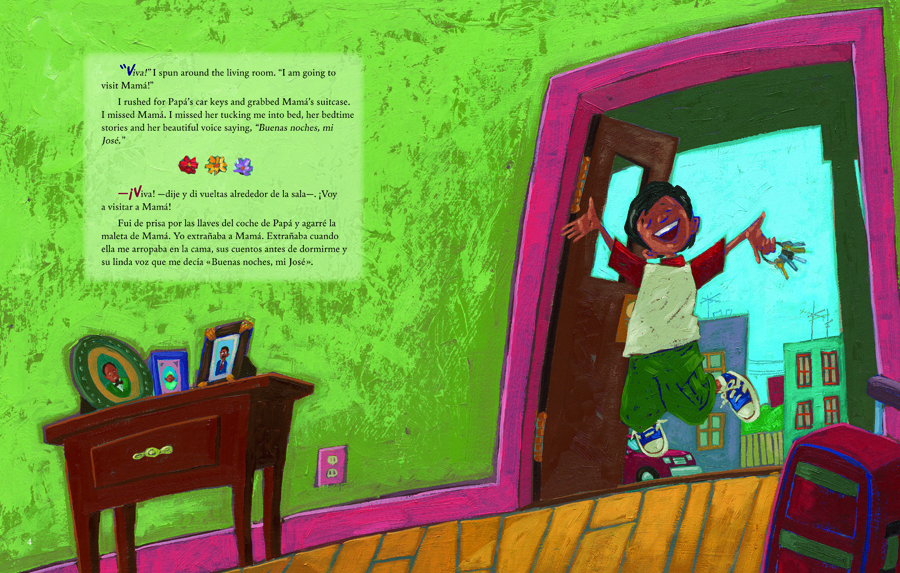
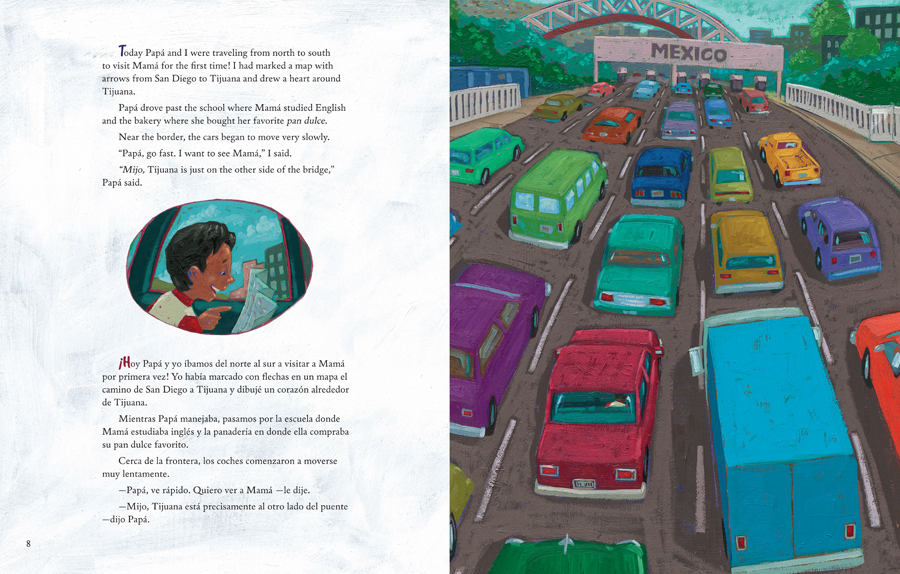
In the beginning of the story, we see how thrilled and excited José is to finally be getting to visit his mamá. Then we are taken down memory lane into what life was like before Mamá was taken away from them. As they are driving south to Tijuana, René writes about places Mamá has gone to in her life in San Diego, the school where she studied english, her favorite bakery to get her favorite pan dulce. These descriptions, along with the bright and vivid illustrations, bring the characters to life for the reader. Just like them, the characters are living normal lives, going to school and eating their favorite treats. This portrays a family of the latinx culture and background in a positive and relatable light. The illustrations act as reinforcement to the story being told. The illustrations are bright, vivid, and lively. Each picture invites you into the story and the lives of the characters. Readers could look through this book and discuss the various emotions of the characters at any point in the story. I think the bright colors used are also very representative to the art of Mexico.
Critical Literacy
There are so many great aspects to this book and many ways to use it to enhance students’ critical literacy abilities. Learners can focus on the many vocabulary words that might be new to them, such as citizen, immigration, immigrant, immigrant papers, deportation. What does it mean to be a citizen? Why do people immigrate? Why do they need papers? Why do people get deported? Is it okay to separate families for any reason? Does the trauma end if and when families are reunited? All of these aspects can lead to social justice action. There is much work to be done for justice around immigration policies and the separation of families. Why does where you are born determine where you have to live?
Any child reading this book, with the main character being a child, can feel empathy for him and his family as they go through this painful situation. José might be happy and hopeful right now because he gets to visit his Mamá, but how long will he have to wait for her to return? What about the families that do not have the privilege of being able to visit their separated family member? What about the stories where both parents are deported? There’s so much to think about and so much we can do to help.
2010 Mythopoeic Fantasy Award for Children’s Literature
About the author
Grace Lin is a American author and illustrator of children’s picture books, early readers, and young adult novels. She is a New York Times bestselling author and many of her books have received awards and honors. Grace Lin focuses on the Asian-American experience in her books Lin also co-hosts a book podcast with her best friend Alvina Ling titled Book Friends Forever. The podcast is about friendship, books, publishing, and life!
A book can show you the world!”
Grace Lin – Tedxtalk
Book Summary
Where the Mountain Meets the Moon is a fantastical adventure set in a poor village near the Fruitless Mountain where Minli lives with her Ma and Ba. Minli is a young girl that works with Ma and Ba in the rice field. Minli’s father, Ba, loves to tell her old folktales and stories about dragons and the Old Man on the Moon. After meeting a goldfish merchant, she buys a goldfish that she is told will change her family’s fortune. Little does Minli know, that this simple purchase, would indeed change her fortune. She sets out on a journey to find the Old Man on the Moon, for he is the one that could answer all her questions and she finds so much more than she ever asked for.
As much as kids need books to be mirrors, kids need books to be windows. Kids who always see themselves in books need to be able to see things from other viewpoints.”
Grace Lin – Tedxtalk
Modern Fantasy
I fell in love with this book and couldn’t put it down until I was done with it! Where the Mountain Meets the Moon falls into the genre of modern fantasy, but also has some traits of folklore in it, and Grace Lin does an exceptional job at creating a magical, fantasy world full of adventure, dragons, and heroism. The book portrays many characteristics of a modern fantasy story, such as “strong, believable characters” (Tunnell, Jacobs, Young, & Bryan, 2016, p. 123). Minli is described as “not brown and dull like the rest of the village” but as a young girl with “glossy black hair with pink cheeks, shining eyes always eager for adventure, and a fast smile that flashed from her face. When people saw her lively and impulsive spirit, they thought her name, which meant quick thinking, suited her well.” (pg. 2). Through this description, Minli is brought to life.
The story also displays a “strong, credible plot” that “examines issues of the human condition” (Tunnell, et al., 2016, p. 123). Minli is the hero in this story, who goes on an adventure to change her families fortune. Minli being from a poor family and village, where her parents work hard, fight, and generally seem unhappy with their situation, are all aspects of the human condition. Her father loves to tell her stories, stories Minli loves to hear even though her mother “never quite approved of Ba’s stories” (p. 7), and these stories act as a sort of glue the holds the plot together and moves the adventure along. Each story gives the reader background information about the settings and characters.
According to Tunnell and colleagues (2016), there are six basic motifs to fantasy stories: magic, other worlds (secondary worlds), good versus evil, heroism, special character types, and fantasy objects (pp. 126-129) and Where the Mountain Meets the Moon features something from each motif.
There are elements of magic with dragons born from paintings, the Book of Fortune, strings of destiny, moon rain, dragon pearls, the paper of happiness, and magical rope bridges built from a kite string leading far above the clouds.
The whole story is sort of set in other worlds as Minli journeys to find the Old Man of the Moon. There’s the Fruitless Mountain, the Dragon Gate that is the “entryway to the sky” (p. 92), the City of Bright Moonlight, the Inner City where the King lives, the Village of the Moon Rain where seed rain falls from the sky each night, and Never-Ending Mountain.
There is definitely good versus evil with the selfish Magistrate Tiger that abuses his power and punishes those that he believes have wronged or tricked him. There’s also the angry and destructive Green Tiger, the spirit of the magistrate, that has poisonous teeth and also seeks to punish all that have wronged him. There are greedy monkeys that won’t let anyone near the peach trees because they want all the peaches for themselves. The Green Tiger is defeated by the twins Da-Fu and A-Fu. The Jade Dragon was in control of the clouds and stopped giving the villagers rain when she felt they were being ungrateful of her power to gift them rain, thus giving way to the Fruitless Mountain and the despair and poverty of the village where Minli now lives. The darkness of the Fruitless Mountain ends when Minli returns from her journey and reunites Jade Dragon with one of her dragon children. One of the main good versus evil themes is with the person versus self, Minli goes on this journey to discover that she had good fortune all along. Family and gratitude is far greater than endless wealth.
Minli is the hero in this story and she follows the circular pattern with her journey, “ending where it began” (p. 127). She begins her journey at the village near the Fruitless Mountain, travels far and wide away of the safety of her home and parents, until she finds the Old Man on the Moon, then returns back where she started, bringing good fortune to her family and village. On her journey, Minli overcomes challenges she never imagined or knew she could overcome, discovers the power of friendship, matures with her new understanding of what “fortune” and “happiness” really mean, and finally returns home.
There are many special character types in this story. The goldfish merchant sells her a talking goldfish that invites her on her quest. She meets the dragon that cannot fly that becomes a dear friend and protector to her on her journey. She meets the boy and his water buffalo that also end up being friends and protectors to her. The friend of the boy with the water buffalo is revealed at the end to be the Goddess of Weaving. She knew where Minli could find the King. Then there is the Old Man of the Moon who controls the strings of destiny and holds the Book of Fortune. He is the one that answers all the questions, but he only answers one question every 99 years.
The fantasy objects are weaved throughout and overlap with the elements of magic, the Book of Fortune and the strings of fate for example. There’s the talking lion statues that are the Guardians of the City. There is also the dragon’s pearl that Minli removes so that the dragon can finally fly, allowing them to make the journey back home and thus reuniting the dragon with its mother, the Jade Dragon. The dragon gifts the pearl to Minli and is apparently “worth the Emperor’s entire fortune” (p. 231).
Critical Literacy
As McLaughlin and Devoogd point out, taking the critical stance while reading is an additional stance to take next to the efferent and aesthetic stances (2004). Students can be in more than one stance at a time, so not only could they be viewing the literature by how it makes them feel, aesthetic, or by gathering the facts, they could be thinking critically about what the author’s purpose was for writing the literature and who’s voices are present or missing. Where the Mountain Meets the Moon would be a great book to use for students to practice being critics and using their background knowledge to make connections between the book and the world around them.
Books erase bias, they make the uncommon common, and the mundane exotic. A book makes all cultures universal.”
Grace Lin – TedxTalk
Disrupting the commonplace and Social Justice Action
In Where the Mountain Meets the Moon, Minli is faced with the reality that she is from a poor family in a poor village. Minli and her Ma and Ba all work in the rice fields all day, but still barely have enough rice to feed them. What Minli and her parents too, need to learn, through her adventure to change her family’s fortune, is gratitude and thankfulness for what they do have. Students may take some time to discuss the implications of poverty and how being poor can affect people. The villagers all work hard, yet they are still poor. Does this happen in real life? Why does this happen? What does poverty look like in our society? How can we lessen the effects of poverty? What if we were all more hospitable to each other like the boy and the water buffalo were to Minli, or the King when he magical grew a peach tree in the middle of the town for all the people to be able to eat peaches?
Interrogating multiple view points
This is also a great book for students to “see” from many different perspectives as well as how all the characters are so interconnected. The main story is told from Minli’s perspective. Through this, the reader can jump right into her mind and know firsthand how each step in her journey affects her and makes her feel. Minli matures over her journey and discovers the power of friendship, gratitude, and selflessness and that all of this was already inside her. Another perspective is that of the Asian experience, which Grace Lin makes a point to add to all of her work since it is one she never saw represented while growing up and one she needed. Grace Lin grew up trying to ignore the Asian part of herself because of the lack of representation. It is very important for children to find themselves in books, like a mirror, as well as for cultural outsiders to see other cultural experiences represented, like a window (Lin, 2016).
The reader also gets to see life from her parents’ perspectives. They can see how they react to being poor. Minli’s mom comes off as bitter and the thought of their situation is always at the forefront of her mind. Her father seems to not let their poor situation affect him too much and he tries to enjoy the time he has with his daughter through storytelling. The reader gets to experience how the parents handle their daughter being missing. First they are distraught and try to find her, but then they learn to have faith in their daughter to return home, but of course they are still very worried. “‘But now,’ Ba said, ‘I think, perhaps, the word was faith.'” (referring to the Story of the Paper of Happiness, p. 151).
Through the many stories in the book that show how everyone and their actions are interconnected and how they affect each other, the reader also gains a look from the perspective of the Jade Dragon, the Magistrate Tiger, Wu Kang, the Old Man on the Moon, and many others. Every thing that happens in each story shows how connected everything is. This would be a great aspect for students to grapple with. Through this they could discover the power their actions hold. Everything we do could affect someone else in a way we might not have expected. For example, in the Story of Wu Kang, he was a “very lucky” man with a beautiful wife and healthy children, yet he was never satisfied, never content. His endless journey to always do something more or better led him to the Old Man on the Moon where he will stay, forever chopping down the same tree, until he learns to be content. We learn later the the tree he chops down is the source of the moon seeds that rain down on the Moon Rain Village, which grow into the trees that provided them with the Well Tea that cures the poison from the Green Tiger. The connects with these stories go on and on.
Sociopolitical Issues
Students can definitely read this book and think about what the author might want them to learn from it. By putting themselves in all the different characters’ shoes they can experience both the good and the bad, the greed and selfishness, as well as the gratitude, kindness, and thankfulness. Certain characters hold more power over many than others; the Jade Dragon, the Magistrate Tiger, the King, and the Old Man of the Moon. The readers can ponder how each of these characters choose to use their power and the affects this has on others, then compare with people in our society that hold more power over many and how they choose to use it. The Magistrate Tiger is the main character with power whose actions are most selfish and silence the most people.
Stonewall Book Awards 2017 Rainbow Project Book List Walter Dean Myers Honor Book for Outstanding Children’s Literature
About the author
Meredith Russo is an American author of two novels so far, If I Was Your Girl and Birthday. Russo grew up and currently resides in Tennessee. She is a mother to a four year old and a few dozen trans people. She is a nerd that loves video games and is obsessed with Star Wars. Meredith is a transgendered person who started living her true self in 2013. The best way to support Meredith Russo and keep up to date with her writing work is through her Patreon, check it out! —-> https://www.patreon.com/user?u=5075691
Books Summary
The YA novel, If I Was Your Girl, was the first of its kind to feature a trans character, Amanda, as its main character and to also be written by a trans author. If I Was Your Girl was partially based on Meredith Russo’s experience as a trans girl in the south. Amanda is a high school trans girl growing up in the Bible Belt of America. We soon discover that Amanda was assigned male at birth and was able to transition, through surgery and hormone replacement treatment, so that she may live her true self. We also discover that Amanda has been bullied relentlessly basically her whole life and that she even attempted to kill herself. After an altercation in the women’s bathroom, where a classmate recognized her as Andrew, her pre-transition, male presenting self, that ended in Amanda receiving a black eye, Amanda moves to Lambertville to live with her father. She is now far away from everyone who knew here before her transition and is this able to have a fresh start to finish our her senior year of high school. Her goal is to get through her final year of school without drawing too much attention to herself before heading off to college. Her plan doesn’t quite pan out, as she make friends, experiences her first boyfriend, and many of the other rather normal high school girl experiences she missed out on previously.
Features of Contemporary Realistic Fiction
Meredith Russo wrote a very important contemporary realistic fiction novel that falls into the category of a problem novel as well as a school and family novel. The story of Amanda Hardy is on that did not happen, but it is a story that could have happened (Tunnell, Jacobs, Young, & Bryan, 2016). Aspects of Amanda’s story were based off of Russo’s actual experiences as a trans woman growing up in Tennessee, which is another characteristic of contemporary realistic fiction (Tunnell, et al., 2016). Russo mentions in her note from the author at the end of the book that she took some “liberties with what [she] knows[s] reality to be” (pg. 275), so that the reader may view Amanda’s “trans-ness as unchallenging to normative assumptions as possible” (pg. 275). Russo wanted to show the reader the reality of Amanda’s “trans-ness” and that it is one version of reality that is completely possible in real life and that it is not the only version of reality for a trans person to experience.
Not all trans people discover their feelings of gender dysmorphia at such a young age and definitely not all trans people are able to receive the necessary means to transition, as therapy, surgery, and hormones are extremely expensive and not always easily and safely accessible. Not all trans people “pass” externally as the gender they identify as internally, even after going through with transitioning. Some trans people decide not to go through with transitioning. And definitely not all trans people have supportive family members or friends, like Amanda’s mom and eventually her dad and the new friends she makes.
If I Was Your Girl covers topic that wouldn’t have been covered before the mid 1960’s where such topics of negativity and hardship were considered taboo for children’s literature (Tunnell, et al., 2016). I think this that’s what makes this novel as well as many other contemporary realistic fiction pieces so important. Novels in this genre provide a window into real life experiences that real life children and young adults could be going through. This is important because readers of books in the genre can connect with characters either going through similar experiences to their own. Readers can “see” that they are not alone, they are not the only one’s feeling what they’re feeling or going through what they’re going through. Just as well, readers can also connect with characters going through life differently than they are. They can “see” other perspectives, gain compassion and empathy people with different life experiences.
If I Was Your Girl features many relatable and familiar aspects to a young adult. Being that it is the first YA novel written by a trans author with a trans character, it is a very important novel for young trans readers to read for a very authentic and genuine trans story where they could see parts of themselves. Other aspects of Amanda’s story and those of her friends and classmates could also be familiar to a young reader, trans or otherwise, such as getting bullied, trying to fit in, religion, depression, suicide, divorce, starting at a new school, and falling in love. Amanda’s friend Bee is bisexual, Chloe is a lesbian, Amanda’s parents are divorced and her dad hasn’t been in her life since her transition, and Grant’s from a poor family and his mom struggles with her mental health.
Critical Literacy
The trans experience is not one that is greatly represented in literature, let alone young adult literature, so students could benefit greatly from connecting to Amanda’s experience, whether they are trans or not. This book made “differences visible” to the reader (Lewison, Flint, & Sluys, 2002). Trans students can feel seen and represented in literature for probably the first time ever. Cisgendered, or non-trans, students could benefit from connecting to Amanda’s experiences and seeing the world through a lens less familiar, but also very familiar, than their own. Students who do not live in the south, might not understand what it is like to live a life like Amanda’s in a place that is less progressive and accepting to trans people. After walking in Amanda’s shoes, they can empathize with the trans experience and also see themselves in some of the other things Amanda goes through, like her desire to fit in, to be loved and accepted by others.
After reading this novel, students can discuss and ponder various social-constructed concepts, such as gender identity. What is it that makes us who we are? What makes someone a boy and what makes someone a girl? Russo shows us that Amanda’s dad really struggled with Amanda’s gender identity. Before Amanda knew she was supposed to be something other than what she was assigned at birth, a boy named Andrew, her dad would get upset when she didn’t want to do more male-specific activities. “Dad wanted me to play sports, join the scouts, go camping with him and his navy buddies, do whatever it took to ‘toughen me up.’ He asked me to play catch with him once a week. The nights we didn’t, he still looked disappointed, but the nights we did were in some ways worse because I had to watch the frustration grow in his eyes.” (pg. 111). Russo showed us glimpses into her mom’s struggle with the “loss of her son” through Amanda’s transition. Her mom mentions missing her son and Amanda explain that she is still “me”, but, “‘It ain’t that simple,’ Mom said…’I know I’m supposed to say it is, but it ain’t. You look different, you act different, you sound different, your hands feel different when I touch ’em. Hell, you even smell different.'” (pg. 186). Through these excerpts, the reader is able to put themselves in her parents’ shoes and see how they feel about what Amanda is going through. It’s not easy, it’s messy, life is messy, and we can’t always control how we react to things.
Hopefully after reading this novel and experiencing many tough and real situations, students can take this new perspective and awareness to create action for social change and social justice. They can question why the author needed to write this story. Why does Amanda need to hide her past from her new friends and from Grant? What voices are not represented here? What about those of trans people that don’t get to experience a “normal life” like Amanda gets a chance at having? What about the trans people that attempt suicide like Amanda does, but succeed. Why did people bully her before and after her transition? What can we, the reader, do to make sure that these terrible things do not happen to more trans people?
References
Lewison, M., Flint, A. S., & Sluys, K. V. (2002). Taking on Critical Literacy: The Journey of Newcomers and Novices. Language Arts,79(5).
McLaughlin, M., DeVoogd, G. (2004). Critical Literacy as Comprehension: expanding reader response. International Reading Association, (pp. 52–62). doi:10.1598/JAAL.48.1.5
**Winner of the 2016 Newbery Medal **2016 Caldecott Honor Book ** 2016 Coretta Scott King Illustrator Honor Book **#1 New York Times BestsellerA New York TimesBook Review Notable Children’s Book of 2015 NPR Best Book of 2015 Kirkus Reviews Best Book of 2015 Wall Street Journal Best Book of 2015 2015 Publishers Weekly Best Book of the Year Horn Book Best Book of 2015 BookPage’s “2015’s First Must-Read Picture Book” The Huffington Post Best Overall Picture Book of 2015 Boston Globe Best Book of 2015 Chicago Public Library Best Book of 2015 Chosen for the New York Public Library’s 100 Books for Reading & Sharing List Miami Herald Best Children’s Book of 2015 Raleigh News & Observer Best Children’s Book of 2015 Atlanta Parent Best Book of 2015 San Francisco Chronicle Holiday Gift Guide Pick Center for the Study of Multicultural Children’s Literature “Best Multicultural Books of 2015” Scholastic Instructor 50 Best Summer Book Chosen for the ALSC 2015 Summer Reading List Horn Book Summer 2015 Reading List Pick Chosen for School Library Journal’s 2015 Top 10 Latin Books List Kansas City Star Thanksgiving 2015 Roundup Pick Winter 2014-2015 Kids’ Indie Next Pick 2015 E.B. White Read Aloud Award Finalist Nominated for the 2016 Washington Children’s Choice Picture Book Award Nominated for the 2016 Kentucky Bluegrass Award
About the Author
Matt de la Peña is an award winning, American author of young adult novels and children’s picture books. He has written seven young adult novels and five picture books and believes the books provide the reader with a “secret place to feel”. Matt writes books for the reluctant reader as he struggled with reading growing up. His first novel, Ball Don’t Lie, was made into a major motion picture. He currently lives in New York where he teaches creative writing. He was the first Latino author to win a Newbery Medal Award for his book Last Stop on Market Street.
Reading is the ultimate form of empathy. And the more you read, the more you understand, not just yourself, but other worlds and other people, and you become a more compassionate person.”
Matt de la pena
About the Illustrator
Christian Robinson an American animator and illustrator of children’s picture books. As a child, Christian was enthralled with all things creative and spent his time creating art whether it was drawing, painting, or making a sculpture. He loves trying new things and experimenting with different techniques, mediums, and textures with his art. He created Last Stop on Market Street with a mix of collage and paint.
Book Summary
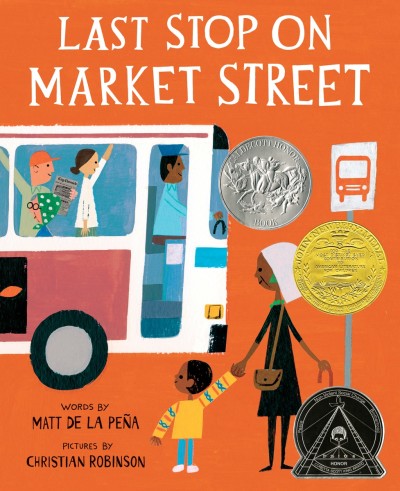
Last Stop on Market Street is a heartfelt story about a boy, CJ, and his grandmother as they take the bus home from church on Sunday morning. The whole ride home, CJ is comparing himself and his life to that of others; Why do they have to take the bus?; Why doesn’t he have an iPod?; Why do they have to get off at a dirty part of town? His grandmother responds, not by dismissing his wonderings, but by offering him reassuring words that encourage CJ to open his eyes to the beauty of the world around him and to focus on what he has, not what he does not have.
The illustrations in this book are stunning and they were created by a mix of paint and collage. The tone of all the images is very light and bright, which is likely to draw the attention of readers young and old. The images are also pretty flat, simple, child-like, and playful, which contrast the more complex messages found in the story, such as gratitude, observation, and community service. The illustrations are also used to reinforce what is told in the story. They show the reader the city, a city that may be similar to their own, and all the people they encounter on their bus ride to the soup kitchen. The reader can see CJ looking out the window at his friends as he wonders why they never have to go anywhere like him or his face as he observes the two people listening to something with their headphones. They can see CJ close his eyes to allow the music from the guitar player on the bus to take him to a magical place inside his imagination. They can see the rainbow that CJ might have missed had he only been looking at the dirtiness of the city.
CJ saw the perfect rainbow arcing over their soup kitchen. He wondered how his nana always found beautiful where he never even thought to look.
Last Stop on Market street, pg. 25
Readers can enhance their visual literacy with this book as they look around the pages to see what they notice about the city. They can easily connect to the how CJ is feeling and relate the events in the story to things they might do in their life. If they take nana’s advice to slow down and observe while reading this book, they are sure to notice more things than I can note in this blog. Another great aspect of the illustrations is the art on the front and end papers. They are bright yellow with a pattern of shapes and objects that can be found within the book as well. It would be fun to have students make note of those objects on the end papers and see if they can find them while reading.
Last Stop on Market Street is contemporary realistic fiction as it is a small snapshot of a day in a young boys life with his grandmother, something that could be a part of any young child’s life. As Tunnell, Jacobs, Young, and Bryan (2016) point out in Children’s Literature, Briefly, “everything in contemporary realistic fiction is possible on planet Earth” (pg.137), and everything that happens in Last Stop on Market Street could have happened. When children read this book, or get read this book, they could see themselves in CJ, feeling his feelings and wondering his wonderings. They might have a grandmother or other adult figure that is just like CJ’s grandmother. Maybe after reading this book, they would feel more inclined to focus on the beauty that is around them and how they can create beauty through helping others as CJ did.
This would be a great book for interrogating multiple viewpoints. What is it like to walk in CJ’s shoes? de la Pena makes the feel like we are walking in CJ’s shoes right along with him and his grandmother. The reader can also contemplate with it is like to walk in his grandmother’s shoes. Why does she say what she says to CJ? Do the students know what it is like to not have a car, to not iPods, to serve people at a soup kitchen?
de la Pena grew up not seeing himself represented in books, which led to his apprehension and struggles with reading (2013). Now he writes books with the hope of catching the eye of reluctant readers like himself so that they may find themselves in the literature and learn more about themselves in the process. He believes that this makes for more empathetic people. The little mystery in Last Stop on Market Street is where CJ and his grandmother are even going on the bus that Sunday. The book ends with them volunteering at a soup kitchen. Reading this book could spark conversation about social justice issues and community service. Helping others can contribute to creating more beauty in the world. CJ was apprehensive about going to the soup kitchen until he saw some familiar faces, then he was glad they went, showing his character’s empathy and his willingness to set aside his doubts for the good of others.
Written by Laurie Halse Anderson Young Adult Novel Historical Fiction
Awards
ALA Best Books For Young Adults
ALA Notable Children’s Books
ALA Popular Paperbacks for Young Adults – Top Ten
Beehive Award Master List (UT)
Booklist Editors’ Choice
CBC/NCSS Notable Social Studies Trade Book
Capitol Choices List (DC)
Charlotte Award Suggested Reading List (NY)
Garden State Teen Book Award Nominee (NJ)
Georgia Children’s Book Award Nominee
Golden Sower Masterlist (NE)
Grand Canyon Reader Award Nominee (AZ)
IRA Teachers’ Choices
Maine Student Book Award Master List
NYPL 100 Titles for Reading and Sharing
National Book Award Finalist
Nutmeg Children’s Book Award Nominee (CT)
Pacific Northwest Young Reader’s Choice Award
Pacific Northwest Young Reader’s Choice Award Master List
Parents’ Choice Gold Award Winner
Pennsylvania Young Reader’s Choice Award Nominee
Publishers Weekly Best Books
Rebecca Caudill Award Master List (IL)
Rhode Island Teen Book Award Nominee
Rodda Book Award Nominee
Scott O’Dell Award
Texas Tayshas Reading List
Thumbs Up! Award Master List (MI)
Truman Reader Award Nominee (MO)
Volunteer State Book Award Master List (TN)
Washington Post Best Books
West Virginia Children’s Book Award Master List
About the Author
Laurie Halse Anderson is an award winning and New York Times bestselling American author. She has written picture books, non-fiction, YA fiction, adult fiction, as well as her memoir, SHOUT. She was honored by the National Coalition Against Censorship and the National Council of Teachers of English for fighting against censorship. Her books have won many awards, including Chains and Speak (which is also one of my favorite YA novels that I read in high school).
Book Summary
Chains is a historical fiction book set during the Revolutionary War. The story is told from the perspective of Isabel, an enslaved young girl. Isabel and her sister Ruth were promised their freedom by their enslaver, Mary Finch, upon her death. Suddenly, Isabel and her sister are sold by their previous owner’s nephew to the Locktons. The Locktons are a malicious, rich, and fence-straddling, loyalist couple, notorious for their maltreatment of the people they enslave. When Isabel meets Curzon, a young boy enslaved by Mr. Bellingham, a Patriot, she is encouraged to spy on her Loyalist enslavers. She is hesitant at first, but finds her self needing to wager for her freedom after something terrible happens to Ruth.
Historical Fiction
Laurie Halse Anderson wrote a very powerful piece of historical fiction that takes place in a time before her own, during the Revolutionary War from 1776-1777. Most of the characters are fictional, but she does include some that are based on real, notable people of that time, such as General George Washington, New York mayor David Matthews, Thomas Hickey, and Dr. Abraham van Biskirk. In addition, many of the events that take place are actual historical events, such as various battles, that happened during the Revolutionary War.
The reader gets to see a unique perspective that isn’t normally presented in history books or historical fiction, that of an enslaved girl named Isabel. While Isabel isn’t a real girl that was enslaved during that time period, her story, her emotions, and her struggles were very real. It is through Isabel’s eyes that the reader experiences the pain of losing Ruth, the fear of sneaking around behind her enslavers’ backs, and her strength as she endures and perseveres through many hardships.
Laurie Halse Anderson has clearly done her research to make this historical fiction novel a reality. She demonstrates this in a few ways. One way is through the use of short excerpts of historical letters or other texts from that time period at the beginning of each chapter. Anderson would also add the date (i.e. Monday, May 27, 1776) to connect the reader to a specific time in the past. In chapter 1, it read, “‘Youth is the seed time of good habits, as well in nation as in individuals.’ – Thomas Paine, Common Sense.” I felt these excerpts always connected to the situation Isabel was going through in that chapter. They helped connect the fantasy to the reality. In addition, she provides an Appendix at the end of the book, that responds in detail to some common questions and concerns regarding the historical accuracy of the novel.
Anderson utilizes figurative language and musical writing to “show” rather than “tell” the events in Chains. But she also uses a few visual elements. The biggest and most obvious is the cover art, created by Christopher Silas Neal. The imagery on the cover is very powerful and depicts a small black child with their arms in the air and the title, Chains, on a ribbon are across their arms. There is also two birds placed on either side of the child, one with the British Flag and one with the American flag. Another small visual technique used within the book creates a sense of the past was the fancy font used for the date at the beginning of each chapter and the first letter of the first word of each chapter.
There is some really powerful figurative language and rich, vivid descriptive language in Chains that really paints a picture in the mind of the reader. For example, the use of “bees” to describe how Isabel felt in her mind. Describing her racing thoughts as bees is very clever and relatable. This language is used throughout the novel. The bees visit her mind often after scary or terrible things happen to her or her sister. Madam Lockton threatens to sell Ruth after she has her first seizure, what are described as her “peculiar ways”, in front of the Madam.
Strangest of all was the hive of bees that had taken up residence inside of me. They swarmed under my skin and gave off peculiar vibrations. The buzzing echoed in my brainpan and crowed out my thoughts. The fire in me burned on and on.”
chains, pg. 148
Another powerful scene that demonstrates Isabel’s character growth takes place in sick Lady Seymour’s room. Lady Seymour is dying and is feeling remorse for her failed attempt or lack of attempt to purchase Isabel and Ruth. Lady Seymour does not approve of the malicious way that Madam Lockton treats her slaves. Isabel relates how Lady Seymour is acting to the way her previous enslaver, Mary Finch, acted when she was close to death. But now, much has happened to Isabel and she is stronger now, she does not see the use in easing the mind of the dying lady. She understands that Lady Seymour had good intentions, but she realizes that good intentions do little to help her out of enslavement. Isabel wants to know why she thought of buying her, but didn’t think of freeing her.
It would have eased her mind if I thanked her for wanting to buy me away from Madam. I tried to be grateful but could not. A body does not like being bought and sold like a basket of eggs, even if the person who cracks the shells is kind.”
Chains, page 245
It was Christmas Day, the one “free” day that Isabel got a year with no work, but Madam had a different idea. Madam made sure that Isabel had work to do and when she was done she threatened her for having gone to the prison to feed the prisoners, or rather Curzon. She threatened to sell her like she did to Ruth. Isabel thought, “She can do anything. I can do nothing.” (pg. 232). The reader can feel and share in her helplessness and sadness, “The ashes of sadness and the buzzing bees of my melancholy all spin a storm inside of me” (pg. 232). Isabel’s character grows quickly on this page, during her “free” time, as she looks across to New Jersey, foreshadowing the events ahead. “A thought surfaced through my ashes.” (pg. 232).
She cannot chain my soul.”
Chains, pg. 232
This is a turning point for Isabel, a fire is burning inside her and she is more determined than ever to do whatever it takes to survive, find her sister, and live free. The revelation that no one can chain her soul. No matter how evil or cruel, she can persevere. Isabel is consistently portrayed as “unique and believable” (Tunnell et al., 2016, p. 17). The reader can emotionally connect to her character as she fights through her fears and holds on to hope.
References
Anderson, L.A. (2008). Chains. New York: Simon & Schuster.
Written by Troy “Trombone Shorty” Andrews Illustrated by Bryan Collier Non Fiction Picture Book Autobiography
Awards
2016 Caldecott Honor Book
2016 Coretta Scott King Illustration Award Winner
About the Author
Troy Andrews grew up in a famous musical family in New Orleans where he started playing the trombone at age 4 and he was his first band by age 8. Today, Trombone Shorty plays his music all over the world! Troy Andrews started the Trombone Shorty Academy, which is an after-school music program for high schoolers in New Orleans.
About the Illustrator
Brian Collier is an award winning American writer and illustrator from Pocomoke, Maryland. He won the Coretta Scott King award for his illustrations in Trombone Shorty. He also won the Ezra Zack Keats award for new illustrator for his work in Uptown. It is interesting to note Ezra Zack Keats’ A Snowy Day was the first book he remembers reading by himself. His illustration style is very powerful and unique. His combination of watercolor and collage really brings stories to life.
“Collage is more than just an art style. Collage is all about bringing different elements together. Once you form a sensibility about connection, how different elements relate to each other, you deepen your understanding of yourself and others.”
-www.Bryancollier.com/bio.hph
Book Summary
Trombone Shorty is an autobiography written by Trombone Shorty himself, aka Troy Andrews. It is all about where he grew up, how he received his nickname and his love for music. The book guides us through his life in the Tremé Neighborhood in New Orleans. He was heavily influenced by the music all around him and his family members also played many instruments. Troy Andrews got his nickname when he started playing the trombone at 4 years old. His trombone was twice as big as he was and he carried it everywhere he went, he even took it to bed. And thus, Trombone Shorty was born.
Visual Literacy
Trombone Shorty would be a wonderful picture book to use to support and advance the reader’s visual literacy. The illustration in this book are so striking and powerful and are even more-so when tied with the story of Trombone Shorty. Bryan Collier used watercolor and collage to bring the story and the music behind the story to life. The pictures in picture books should “beg for active participation in their viewing” (Tunnell et al, 2016, p. 36) and I think that the pictures in Trombone Shorty do just that. It is hard not to be drawn to the images on each page. My eyes danced around, trying to take in every little detail. The images help the reader get to know the Treme Neighborhood, the people that live there, and the music they played. It is not hard to see how Troy developed a love for music as it was so very appreciated and special to him, his family, and everyone in his neighborhood.
Collier uses bright and vibrant colors to portray the bright and vibrant culture of Treme, New Orleans. The colors used are warm and inviting, no doubt a representation of what it’s like to walk down the musical streets in this neighborhood. Andrews writes of his love for his neighborhood and calls it his “greatest inspiration”. On this page (pictured below) the reader sees balloons floating in the air and the use of lines and color to give the sense of movement. The balloons are a metaphor for the music one could hear. Andrews writes, “Any time of day or night, you could hear music floating in the air.”
Almost every illustration is set outside in his neighborhood. Trombone Shorty is also rarely by himself on the page. This is purposefully done to demonstrate the important influence his neighborhood and the community have on his life. Everyone is his friend, everyone is his family. They raised him and they raised him to love music. At one point he mentions that his brother and uncle are also magicians and Trombone Shorty wanted to be just like them. Despite not having “real instruments”, Troy and his friends would pretend to be in a band with instruments they made (pictured below). The imagery on this page is magical. You can see how happy the children are to be making music in a band even though they don’t have real instruments”. They didn’t let anything stop them. I love the crowns on their heads as I feel like it shows how proud of themselves they are. From this image on, Trombone Shorty always has a trombone in his hands.
In addition to the illustrations, the author utilizes different fonts and ways of placing words on the page, mostly with the phrase “WHERE Y’AT?”. “WHERE Y’AT is a unique part of the community’s language, it is used as a greeting. These words are always in all capital letters, bold, larger than the other text, and are wiggly. I think this shows the importance of the phrase and is yet another way that movement is created. “TROMBONE SHORTY”, as shown above, is in all capital letters and larger than the other text since this is when he gets his nickname from his brother. The larger letters signify the importance of this moment in his life.
The image where Trombone Shorty is seen sleeping with his trombone is the only one where he is alone. This is also the only image with cooler tones used. I think this all plays to the intimacy of his personal connection to his music. The cooler tones aren’t sad, but rather calm and peaceful. Troy has a smile on his face and is hugging his trombone tightly. This page is right after his brother officially came up with his nickname, a nickname that Troy is very proud of.
This image is powerful! What an exciting and unforgettable moment for Trombone Shorty! He was able to get on stage and play with a legend. The illustrator showed the magnitude of this event by making Trombone Shorty and his trombone larger than everything else on the page. Bo Diddly is happily looking after the young musician, something that Trombone Shorty will do later on in his life. This image portrays how powerful music can be and how Trombone Shorty’s music took him out of his neighborhood and into the world. No matter what though, Trombone Shorty’s heart is in New Orleans and he always goes back to be a musical influence to young musician there.
Transactional Theory
Transaction theory is all about the importance of the relationship between the reader and the text. The text without a reader is merely words on a page. This book would be an amazing opportunity for students to view it from an efferent stance. The teacher could ask them to read the story once through, but only having them read the pictures and not the words. The students could then respond with the ways they felt while looking at the pictures. What made them feel that way? What things stood out to the students and why? Students could also read this story without any specific goal in mind so that they could then react to how the story made them feel and discuss the things they found a connection to while reading.
References
Andrews, T. (2015). Trombone shorty. New York: Abrams Books.
Written and Illustrated Cece Bell Graphic Novel Memoir Autobiography
Awards
John Newbery Medal
About the Author/Illustrator
Cece Bell is an American children’s book author and illustrator. She was born and raised in Richmond, Virginia. She studied art and illustration in college. Cece Bell has written many books including, El Deafo, I Yam a Donkey, and Itty Bitty. She is also married to another children’s book author, Tom Angleberger, whom she has also co-written books with.
Book Summary
El Deafo chronicles the life of Cece, her hearing loss, and her quest for a true friend. At age 4, Cece gets very sick with meningitis and loses her hearing. The reader is taken on Cece’s coming of age journey through hospital stays, to doctors visits, making friends, losing friends, moving and changing schools and even her first crush. Cece has to navigate wearing hearing aides with long cards and lip reading to help her communicate and understand others. She has to wear a really powerful hearing aid while at school that she is very self-conscious of, but is later the source of El Deafo’s all hearing super powers. As Cece’s journey progresses, she eventually finds her place in her world and a true friend that appreciates her for who she is, deaf, glasses, and everything in between.
I’ve read a lot of graphic novels myself, but never got the chance to experience them in a classroom setting. As they have grown in popularity since then and they’re now becoming more acceptable in schools, I am very excited about the possibilities. I think they are a great tool to engage students and cultivate an interest in and love of reading. El Deafo would be a great novel to use with upper elementary and middle grade students. This touching and funny story about Cece’s life was portrayed with cute animal characters that are brought to life by Cece’s cartoon illustrations. Bell (2015) mentions that she felt that a graphic novel would be the best way to show readers her story, especially because of the speech bubbles. Bell creatively uses speech bubbles to show the reader when Cece cannot hear anything, that is when the speech bubbles have no text or when the text is kind of faded (as pictured below). Through this technique, she was able to convey a range of emotions. Cece’s fear is brought to life when she first realizes she cannot hear and she is shown frantically searching for her mother.
Bell also uses humor throughout the graphic novel, sort of like comic relief from the more serious moments in her life. After Cece finds out that she cannot hear and spends even more time in the hospital, she says, “Just because I can’t hear good doesn’t mean I can’t look good.” (pg. 13). This reaction feels so honest and true to a 4 year old.
Cece has to deal with some big changes and Bell is very honest about sharing how she felt while going through all of it. Bell states, in her note from the author in the back of El Deafo, that “while [she] was writing and drawing the book, [she] was more interesting in capturing the specific feelings [she] had as a kid with hearing loss than in being 100 percent accurate with the details.” (pg. 236). Bell was very successful in portraying those feelings as well as many other feelings that I am sure many children, hearing loss or not, could relate to. In addition to all the emotional accuracy, Bell shared some very specific and accurate aspects about dealing with hearing loss, especially during the 80s. I cannot imagine having to have such a large phonic ear strapped to me while going to elementary school (pictured below).
Another literary element she used well was figurative language. Bell used metaphors such as being underwater (pictured below) or being on another planet (pictured above). She paired these with illustrations to help the reader see what it was like to be able to hear and then suddenly not or to have to read lips because what she could hear was a garbled mess of sounds.
The illustrations also brought to life Cece’s imaginings of herself as El Deafo with superpowers. She used this character of herself to cope with being different, other people not understanding what it was like to be deaf, and navigating friendships.
Written and illustrated by Ed Young Fiction Picture Book
Awards:
Caldecott Honor
Boston Globe Hom Book award
California Children’s Media award
About the Author/Illustrator:
Ed Young grew up in China and came to the United States to study architecture, but eventually found his love of art. Ed Young is a graduate of the Art Center College of Design in Pasadena. He has illustrated over eighty books and of those he was also the author of seventeen books. Ed draws inspiration for his picture books and art through the philosophy of Chinese painting. Chinese paintings are usually paired with words. Ed Young has stated that “there are things that words do that pictures never can, and likewise, there are images that words can never describe.”
Book Summary:
This is a story about seven blind mice, each a different color that live near a pond. One day they discover a strange something near the pond. Each day one mouse goes out to try to figure out what the something is. Since each mouse is blind they each find out about a different part of the something. They disagree and fight about what the something is until the last mouse goes out to try to figure it out. The last mouse goes all around the something and pieces together each of the parts to get the whole picture of the something. Then all of the mice go all around and discover that the strange something is an elephant.
The Mouse Moral: Knowing in part may make a fine tale, but wisdom comes from seeing the whole.
– SEven blind mice
The story, Seven Blind Mice, is an adaptation of the Indian fable, The Blind Men and the Elephant. Instead of seven blind men arguing about the appearance of an elephant, it is seven blind mice.
This picture book is a counting book and a concept book that supports learning about colors, sequencing, days of the week, and social issues of taking others’ perspectives and experiences into account. Being an adapted fable, it has a lesson at the end. Students could talk about what the meaning of this moral is and how it can be applied to real life situations.
The visual elements in the story support and advance the reader’s visual literacy. In the beginning, the reader is drawn in by the curious fact that only the tails of each mouse are visible. Ed Young utilizes empty space and a black background which makes the bright colors pop and focuses the reader on the mice. Each mouse is a different color to support counting, one color for each mouse. When a mouse goes to try to figure out what the Something is, the part of the elephant changes to support the mouse’s guess. The color of the part also matches the color of the mouse guessing. There is added texture as well to really draw the readers attention to the illustrations. The mice are almost always in a line, close together or stacked on top of each other. But when they are arguing and disagreeing, they are more scattered about the page to demonstrate the divisiveness of their inability to work together in that moment. Finally, there is a natural toned and gentle texture on the end papers that’s warm and inviting.











 Neverending Stories