

July 2, 2019
From North to South/ Del Norte al Sur
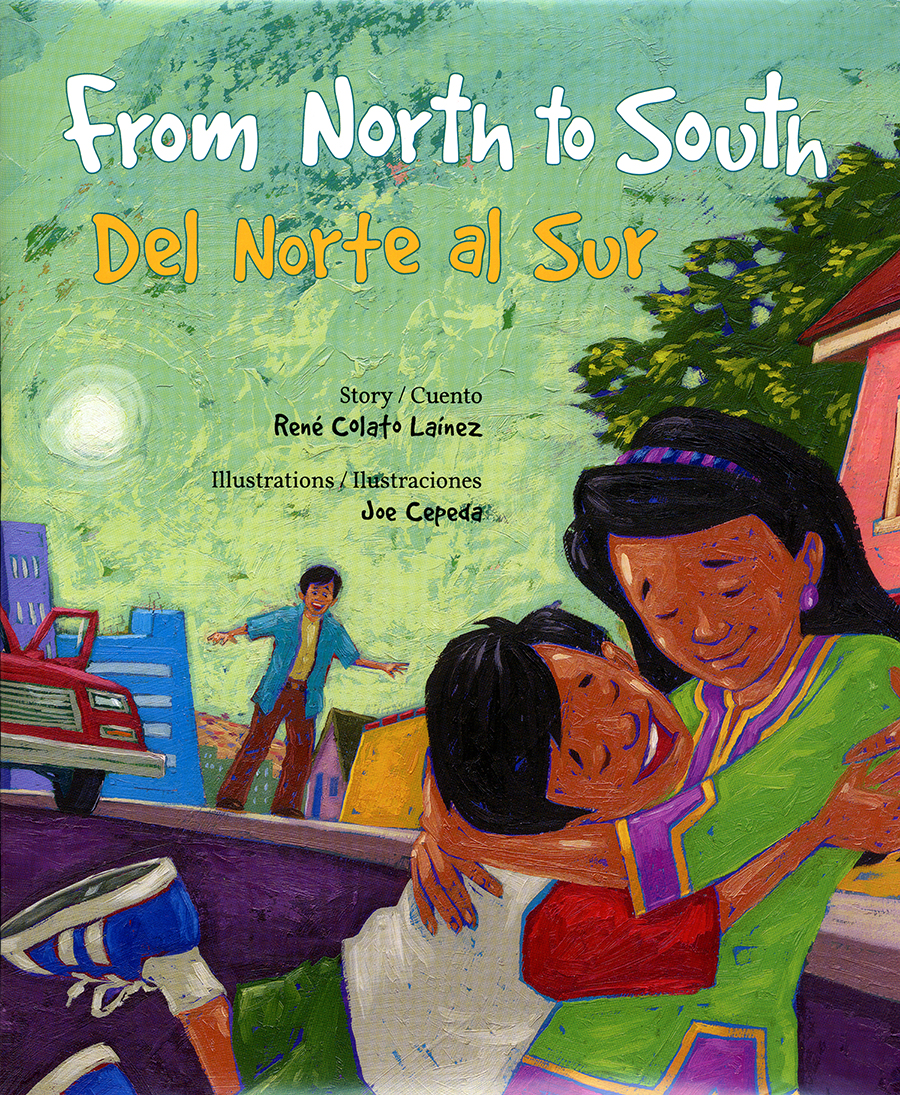
Written by Rene Colato Lainez
Illustrated by Joe Cepeda
Bilingual English/Spanish
Picture Book
Contemporary Realistic Fiction
Multicultural
Awards
International Latino Book Award
Best Bilingual Children’s Book
Americas Award Commended Title
California Book Award Finalist
Tejas Star Book Award Finalist
Junior Library Guild Selection
About the Author

My goal as a writer is to produce good multicultural children’s literature; stories where minority children are portrayed in a positive way, where they can see themselves as heroes, and where they can dream and have hopes for the future. I want to write authentic stories of Latin American children living in the States.”
René Colato Laínez – http://www.renecolatolainez.com
René Colato Laínez is an Salvadoran children’s book author and elementary school teacher where his student’s know him as the “teacher full of stories”. He was inspired by his mother’s famous writer uncle to become an escritor (writer) himself. He draws inspiration for his work from his own immigration experiences from El Salvador to Los Angeles as well as those experiences of his elementary students.
Family separation is a traumatic experience. “
From north to south – introduction
About the Illustrator
Joe Cepeda is an award winning children’s book illustrator and author. He has one the Pura Belpré Honor Award fo his illustrations. He was born and raised in Los Angeles and received his BFA in Illustration from California State University, Long Beach.

Preferring grace over style, message over technique, and story over extravagance, Joe seeks to create work with integrity and authenticity at its core.”
http://www.joecepeda.com/about
Book Summary
The author is donation a portion of his royalties to El Centro Madre Assunta, the refuge in Tijuana for immigrant women and children who have been recently deported from the U.S. and are seeking re-entry into the U.S.
From North To South is a poignant story of a painful experience of family separation. José lives in San Diego with his Papá. His mother was deported to Tijuana because she was born in Mexico and didn’t have immigration papers. José misses working in the garden with his Mamá everyday after school. Papá and José drive from north (San Diego) to south (Tijuana) to visit him Mamá at El Centro Madre Assunta. When will Mamá get to come home?
The story of From North to South is contemporary realistic fiction in that it is a story that is very much a realistic and possible story. As an elementary teacher in Los Angeles, René drew from the very real and current experiences of his students who are facing the very real, painful, and traumatic reality of deportation and family separation. Readers that are also experiencing similar situations to this story will feel a sense of reassurance that comes with being represented in this book. Readers that haven’t gone through anything like this, will hopefully feel empathy towards others in these situations as well as provide them with a lens into racial inequity.
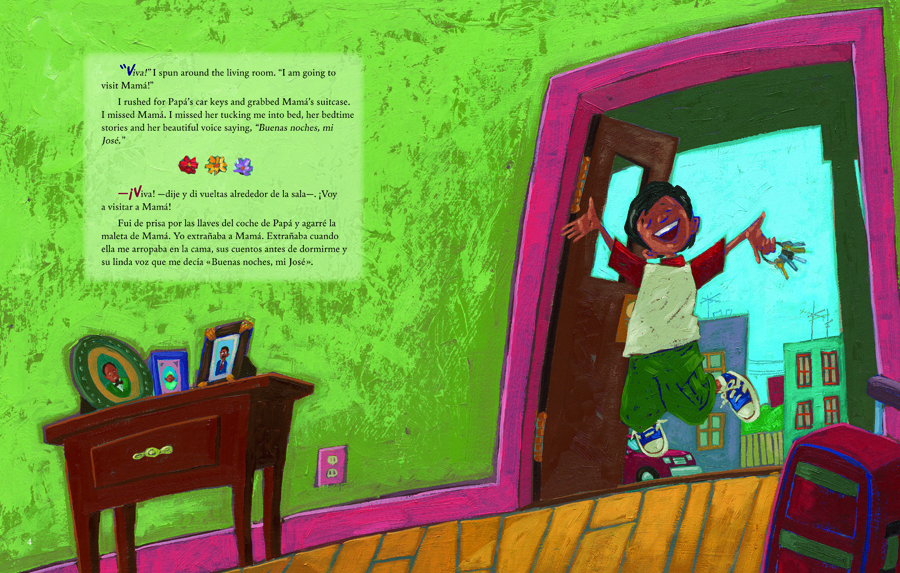
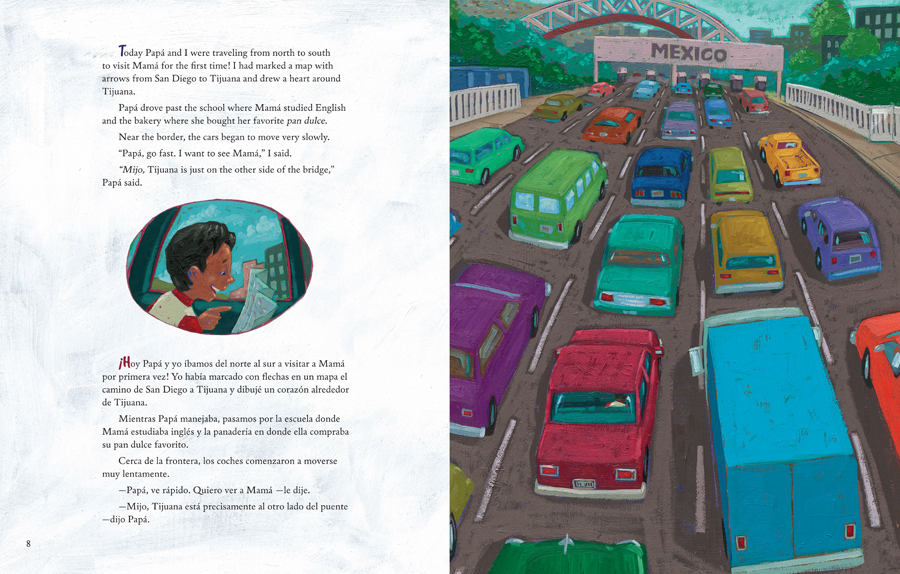
In the beginning of the story, we see how thrilled and excited José is to finally be getting to visit his mamá. Then we are taken down memory lane into what life was like before Mamá was taken away from them. As they are driving south to Tijuana, René writes about places Mamá has gone to in her life in San Diego, the school where she studied english, her favorite bakery to get her favorite pan dulce. These descriptions, along with the bright and vivid illustrations, bring the characters to life for the reader. Just like them, the characters are living normal lives, going to school and eating their favorite treats. This portrays a family of the latinx culture and background in a positive and relatable light. The illustrations act as reinforcement to the story being told. The illustrations are bright, vivid, and lively. Each picture invites you into the story and the lives of the characters. Readers could look through this book and discuss the various emotions of the characters at any point in the story. I think the bright colors used are also very representative to the art of Mexico.
Critical Literacy
There are so many great aspects to this book and many ways to use it to enhance students’ critical literacy abilities. Learners can focus on the many vocabulary words that might be new to them, such as citizen, immigration, immigrant, immigrant papers, deportation. What does it mean to be a citizen? Why do people immigrate? Why do they need papers? Why do people get deported? Is it okay to separate families for any reason? Does the trauma end if and when families are reunited? All of these aspects can lead to social justice action. There is much work to be done for justice around immigration policies and the separation of families. Why does where you are born determine where you have to live?
Any child reading this book, with the main character being a child, can feel empathy for him and his family as they go through this painful situation. José might be happy and hopeful right now because he gets to visit his Mamá, but how long will he have to wait for her to return? What about the families that do not have the privilege of being able to visit their separated family member? What about the stories where both parents are deported? There’s so much to think about and so much we can do to help.
I found a great, comprehensive, teaching resource for this book. It can be found at https://www.leeandlow.com/books/from-north-to-south-del-norte-al-sur/teachers_guide
References
Cepeda, J. (n.d.) Bio. Retrieved from https://www.joecepeda.com/about
Colato Laínez, R. (n.d.) Bio. Retrieved from http://www.renecolatolainez.com/
Tunnell, M. O., Jacobs, J. S., Young, T. A., & Bryan, G. (2016). Children’s literature, briefly (6th ed.). Upper Saddle River, NJ: Pearson.
 Neverending Stories