Basketball, Contemporary Realistic Fiction, Fiction, Multicultural, Poetry, verse novel

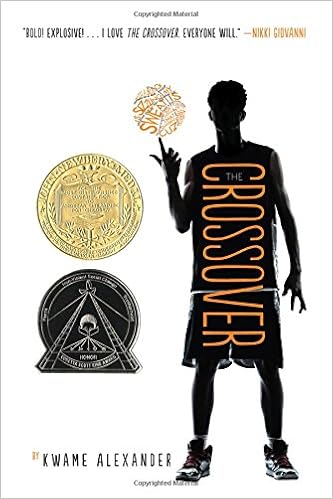
The Crossover

July 2, 2019

The Crossover
Written by Kwame Alexander
Poetry
Verse Novel
Fiction

Awards

2015 John Newberry Medal
Coretta Scott King Award Honor
NCTE Charlotte Huck Award Honor
Lee Bennett Hopkins Poetry Award
Passaic Poetry Prize

About the Author
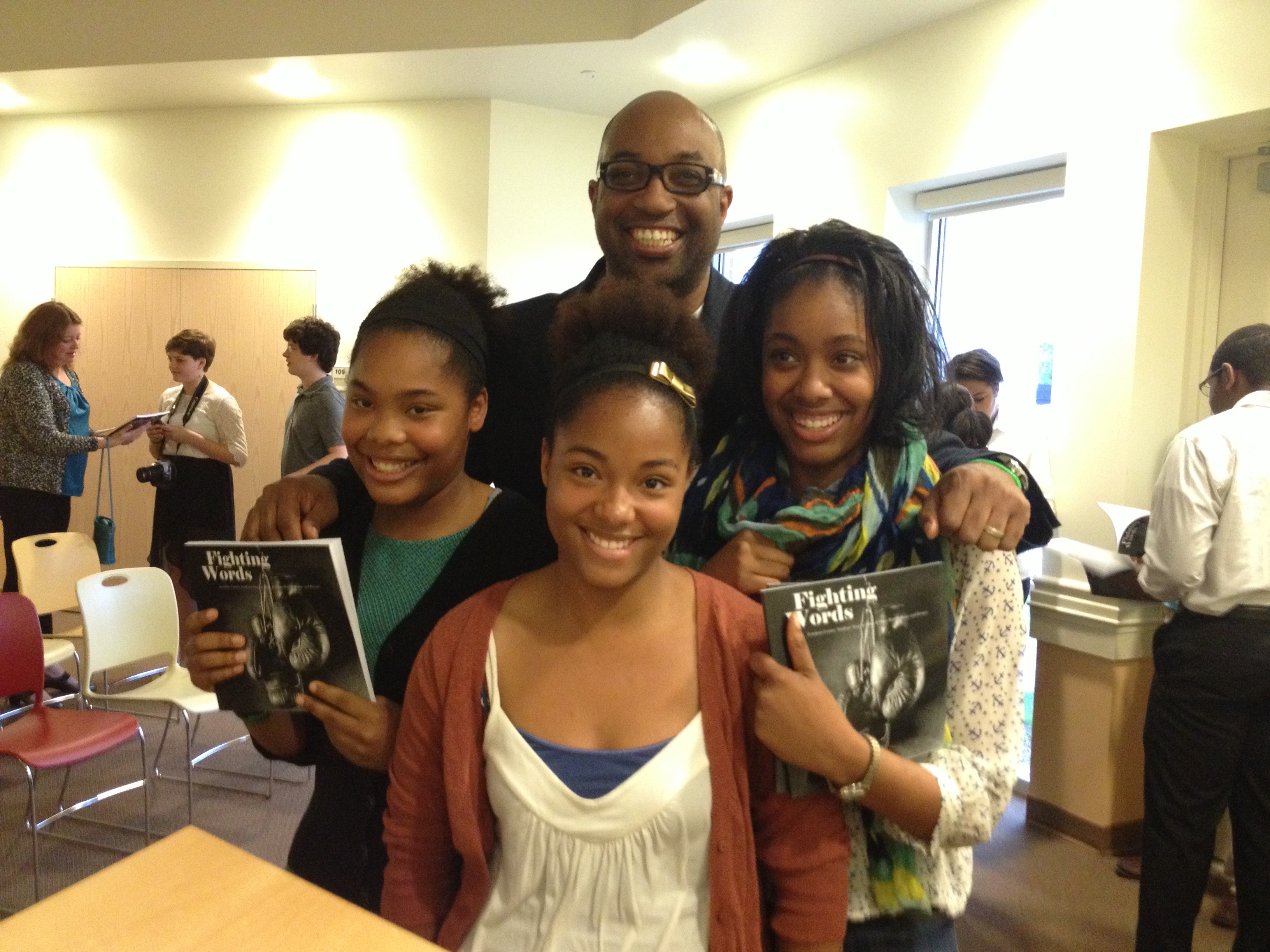
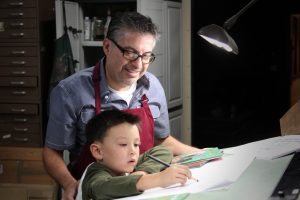
Kwame and his kids!

Kwame Alexander is an inspirational, award-winning poet, educator, and New York Times Bestselling author of 32 books. He was born in Manhattan, NY. His parents are writers and most everyone in his family is an artist of some kind.

Kwame’s belief in the power of poetry and literature to inspire, engage, and empower young people is the guiding force behind the #AllBooksForAllKids initiative he created in partnership with Follett.”

kwamealexander.com/about/me/

Book Summary

The Crossover is a story written entirely in poetry verse and follows the lives of twins, Josh “Filthy McNasty” Bell and Jordan “J.B.” Bell. Josh and J.B. are amazing basketball players heading towards championships. Their dad was previously a famous basketball player in Italy. It is a story of basketball, school, family, first crushes, and loss. When a new girl starts at their school, Josh must deal with the loss of his best friend and twin brother to a girl. Josh and Jordan must navigate more than just basketball as life throws them many new changes and challenges.

Writing Elements

It is great that this is a book of poetry, a book of basketball poetry. This book is one that would likely spark the interest in the reading of poetry in young boys or anyone not usually interested in poetry. The musical and rap-like poetry verses will captivate and engage readers as they follow Josh “Filthy McNasty”‘s life. Tunnell et al. (2016) mention that poetry is often glanced over in classrooms due to a teacher’s lack of appreciation or comfort in teaching poetry. Children also learn to dislike poetry because of this and when teachers make “all the decisions about poetry and its use in the classroom” (p 95). If students were given the option to choose poetry of their own interests, they would likely grow to like and appreciate it. Students would likely read The Crossover and grow to love poetry and all the possibilities it brings for strong, emotional, interesting, and fun writing.

Kwame Alexander utilizes many different poetry forms in The Crossover. What was most noticeable and memorable was his playfulness with words and how for some poems they would be climbing all around the page, with some bigger or smaller text, to really accentuate and bring to life the story being told.


A lot of the poems are in narrative form. They tell stories that happen to Josh and Jordan both at school and at home. Most of the poems are also in lyric form, as Kwame’s words flow with rhythms and beats. Kwame also utilizes mostly free verse since most, if not all, of the poems are unrhymed.

I really enjoyed his use of “definition” poems such as the one titled, hy-per-ten-sion, where the reader finds out the his grandfather died of the same thing his father has. He uses this form of poetry throughout the novel, which is a very unique and interesting way to present information and convey how Josh is feeling about certain things happening in his life.

Critical Literacy

The Crossover provides a lens into the life of a pre-teen black boy. Having a black protagonist is still under-represented in literature today. Readers walk in Josh’s shoes as he and his dad are running late to a basketball game and experience the real fear of being pulled over while black. Readers get to experience his mother’s fear of him being stereotypically labeled as violent after his outburst towards his twin brother. “Boys with no discipline end up in prison.” (p 136). Students may wonder why his mother is so worried, it was just a mistake? Is it because he’s a boy? Is it because he is a black boy? Are these fears and worries that I have to deal with? What is it like to be a black boy in America today?

Readers get to experience what it is like to be a twin boy, both of which are amazing basketball players. They can experience the hurt one twin feels as the other experiences their first girlfriend and starts spending less time with the one person he’s spent his whole life with. Readers can put themselves in the mother’s shoes as she worries about her husband’s health, her children’s education, and her family’s future. They can also put themselves in the father’s shoes as he lives a life after fame vicariously living through his sons, and as combats health issues alongside a fear of hospitals and doctors since his own father’s death.

References

Alexander, K. (n.d.) About me. Retrieved from https://kwamealexander.com/product/

Tunnell, M. O., Jacobs, J. S., Young, T. A., & Bryan, G. (2016). Children’s literature, briefly (6th ed.). Upper Saddle River, NJ: Pearson.

Cultural Authenticity, Immigration, Memoir, Multicultural

The Distance Between Us

July 2, 2019

The Distance Between Us

Written by Reyna Grande
Memoir

Awards

2012 Finalist for the National Book Critics Circle Award
2016 Eureka! Honor Awards from the California Reading Association
2017 Honor Book Award for the Américas Award for Children’s and Young Adult Literature
2017 International Literacy Association Children’s Book Award
International Latino Book Award 1st Place

About the Author


Reyna Grande is an award-winning author and inspirational speaker who was born in Mexico. Reyna came to America at 10 years old as an undocumented immigrant. She later became the first in her family to graduate college. She is and avid promotes Latino literature. She currently teaches creative writing at UCLA.

Book Summary

The Distance Between Us is the true story of Reyna Grande’s life in a poor town in Mexico and her and her family’s journey as they navigate life, poverty, immigration to the U.S., alcoholism and abuse, and simply growing up. Reyna’s parents leave Mexico to find work so they can build a better life for their children back in Mexico. Reyna’s father left when she was only 2 and his head was always filled with dreams, dreams of a better life, a safe house for his family, and opportunities for his children. Reyna and her siblings have to deal with the fact that if their parents are to accomplish their dreams, they have to leave them with grandparents, in poverty, while they cross the border to work in El Otro Lado, “The Other Side”.

Multicultural Elements

Multicultural books are necessary for the representation of the experiences of all humans. “Literature can be one of the most powerful tools for combating the ignorance that breeds xenophobic and judgmental behaviors” (Tunnell et al., 2016, p. 202). Reyna’s memoir is an honest, credible, interesting, and believable story of her actual experiences with poverty, abuse, immigration, and adapting to a brand new culture and environment. Readers can experience the challenges that undocumented immigrants face when moving to a new country; learning the language, adapting to a different culture, and lack of supports like health insurance and family. They can learn that they face racism and ridicule for not “fitting in” or speaking the language. They can learn how it feels when you’re only choice to provide for your family is to leave them behind or risk their lives to take them with you. They can learn how it feels to long to be in two place, two cultures at once.

Was my uncle right? Was it better to be poor but together? Or was it better to try to find a better life, even if it meant breaking up your family?”

p 268

Books serve as a mirror, but also a window. Students who can see themselves in the experiences and lives of Reyna and her family will be able to feel like their experiences are validated and that they are not alone. Students who cannot relate to Reyna’s experiences will be able to use this book as a window into the life and culture of Reyna and her family, as well as many other immigrant people who share a similar story. Reyna’s experiences are not always positive, but they are honest. Students can become empathetic towards those who have experiences just like the ones in the book, whether it be with immigration, poverty, alcoholism, abuse, or abandonment. They can also be proud of Reyna as she follows her dreams, overcomes adversity, and accomplishes her goals.

Critical Literacy

Since we follow Reyna from childhood in Mexico all the way until she graduates college in America, we get to see life from a view different perspectives of hers. When she is a child in Mexico, living with her grandmother, she longs for her mother and father to return so that they can be a family again, and so they can get away from the abuse of her father’s mother. At this time, she can’t quite understand why her parents had to leave them. “Me ama mi mamá? ‘Does my mama love me?’ If so, why is she so far away?” (p 60). But later, after she is much older and has lived in America for a while, she finally gets to visit her family in Mexico. She finds out then that the people in the town where she is from have begun to view her differently, not that she lives in El Otro Lado and is more or less out of poverty in their eyes. “I was no longer considered Mexican enough. To the people there, who’d seen me grow up, I was no longer one of them” (p 270). Readers can discuss why this might happen and how Reyna felt to be disowned by her the people of her home town. Mago shows the reader a different perspective in that she viewed the U.S. as her new home and appeared to actually be trying to erase her connections to her old home. Why would Mago do this? Is she ashamed of Iguala, of her poor background? “Even in her speech, she was trying to erase Mexico completely” (p 272).

Another perspective that shines through is that of her father and how his upbringing and immigration experiences have affected the way he raised his children. Mila would remind the children after he would abuse them that he did not know any better since that was how he was raised. Reyna would explain that it was tiring to hear those excuses and her justifying his behavior. This is very relatable to those that have experienced abuse. Her siblings got out and started families as fast as they could, not trying to pursue the dreams their father tried to instill in them. On the other side of the coin was Reyna. Despite it all, she believed in those dreams and kept fighting for them. This is a very positive and hopeful light to which readers can view Reyna’s experiences. She won her first writing competition, met her hero, Diana, and was the first in her family to ever graduate college.

When my father beat me and insulted me when he was drunk, I’d hold on to the dreams he had given me.”

p 251

Another perspective that struck me, was of Reyna as a new student that only spoke Spanish and the educational inequities she experienced because of this. She was placed in a “regular” classroom and then segregated to a table with the other Spanish speaking students. Socially this excluded them, as classmates would view them as other and because the school and the teachers weren’t trying to include them, why would they? Reyna mentions that the she has an “addiction to reading” (p234), yet it wasn’t until she meets Diana in community college that she gets to experience Latinx literature! If that isn’t a call for more representation of diverse cultures and backgrounds, then I don’t know what is.

For the first time since I’d become an avid reader, I found myself reading about characters who lived in a world like my own, characters with the same color skin as mine. With the same heartaches and dreams.”

p 300

Readers might not have been aware of the struggles of those in poverty, of those leaving everything behind to find opportunities in the U.S., of being an undocumented person just trying to live. Hopefully after reading this book, students would be drawn to take action for social justice against the inequities faced by undocumented immigrants. Most are fleeing circumstances worse than we can every imagine. Reader can learn to question why we have these imaginary borders dividing humans from humans and why because of these invisible lines, people are dying, are being put in cages, and are being taken away from their parents.

‘This is where Mexico ends and the U.S. begins,’ the coyote said. But no matter how hard I looked, I couldn’t tell how he knew that. It all looked the same to me. ‘The line is invisible.’ he said, as if reading my thoughts.

Reyna was 10 years old when she risked her life to come to the US – p 141

References

Grande, R. (n.d.) Biography. Retrieved from http://www.reynagrande.com

Tunnell, M. O., Jacobs, J. S., Young, T. A., & Bryan, G. (2016). Children’s Literature, Briefly (6th ed.). Upple Saddle River, NJ: Pearson.
Bilingual, Contemporary Realistic Fiction, Cultural Authenticity, Immigration, Multicultural

From North to South / Del Norte al Sur

July 2, 2019

From North to South/ Del Norte al Sur

Written by Rene Colato Lainez
Illustrated by Joe Cepeda
Bilingual English/Spanish
Picture Book
Contemporary Realistic Fiction
Multicultural

Awards

International Latino Book Award
Best Bilingual Children’s Book
Americas Award Commended Title
California Book Award Finalist
Tejas Star  Book Award Finalist
Junior Library Guild Selection

About the Author

René Colato Laínez

My goal as a writer is to produce good multicultural children’s literature; stories where minority children are portrayed in a positive way, where they can see themselves as heroes, and where they can dream and have hopes for the future. I want to write authentic stories of Latin American children living in the States.”

René Colato Laínezhttp://www.renecolatolainez.com

René Colato Laínez is an Salvadoran children’s book author and elementary school teacher where his student’s know him as the “teacher full of stories”. He was inspired by his mother’s famous writer uncle to become an escritor (writer) himself. He draws inspiration for his work from his own immigration experiences from El Salvador to Los Angeles as well as those experiences of his elementary students.

Family separation is a traumatic experience. “

From north to south – introduction

About the Illustrator

Joe Cepeda is an award winning children’s book illustrator and author. He has one the Pura Belpré Honor Award fo his illustrations. He was born and raised in Los Angeles and received his BFA in Illustration from California State University, Long Beach.

Preferring grace over style, message over technique, and story over extravagance, Joe seeks to create work with integrity and authenticity at its core.”

http://www.joecepeda.com/about

Book Summary

The author is donation a portion of his royalties to El Centro Madre Assunta, the refuge in Tijuana for immigrant women and children who have been recently deported from the U.S. and are seeking re-entry into the U.S.

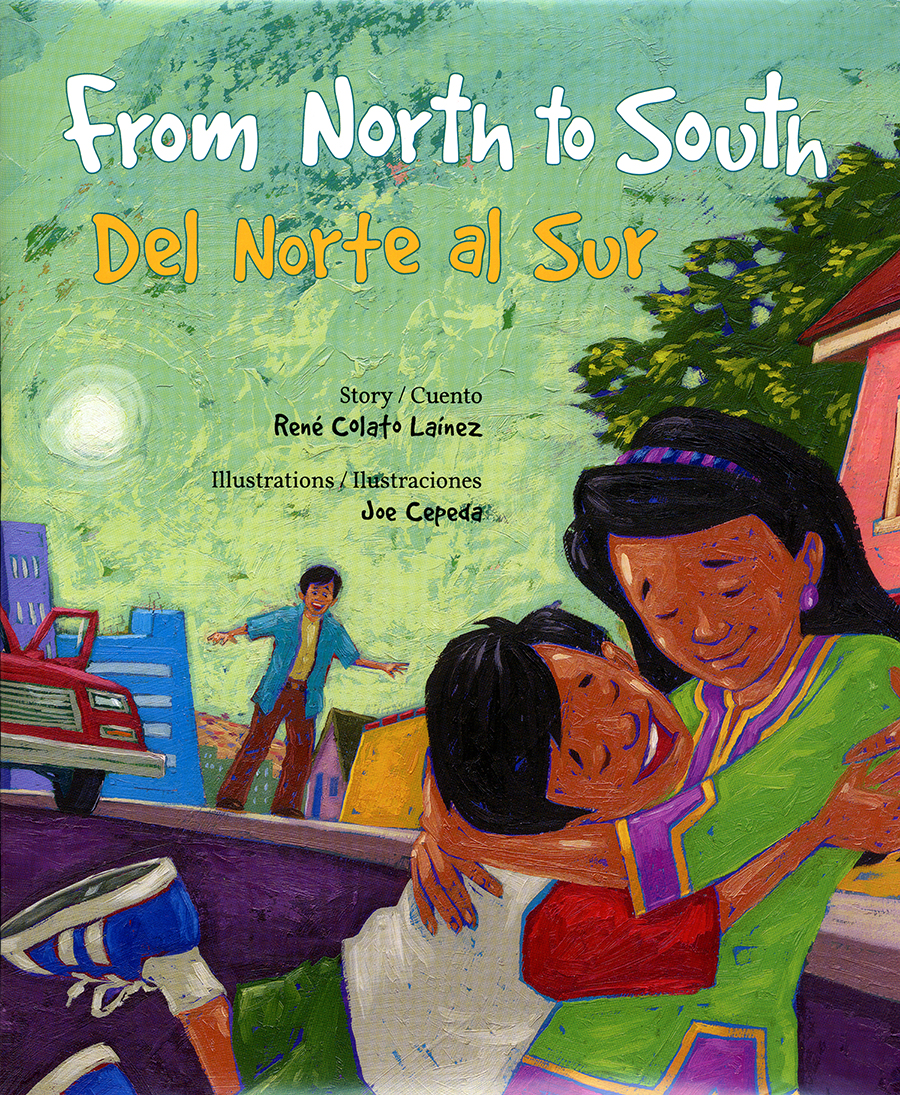
From North To South is a poignant story of a painful experience of family separation. José lives in San Diego with his Papá. His mother was deported to Tijuana because she was born in Mexico and didn’t have immigration papers. José misses working in the garden with his Mamá everyday after school. Papá and José drive from north (San Diego) to south (Tijuana) to visit him Mamá at El Centro Madre Assunta. When will Mamá get to come home?

The story of From North to South is contemporary realistic fiction in that it is a story that is very much a realistic and possible story. As an elementary teacher in Los Angeles, René drew from the very real and current experiences of his students who are facing the very real, painful, and traumatic reality of deportation and family separation. Readers that are also experiencing similar situations to this story will feel a sense of reassurance that comes with being represented in this book. Readers that haven’t gone through anything like this, will hopefully feel empathy towards others in these situations as well as provide them with a lens into racial inequity.

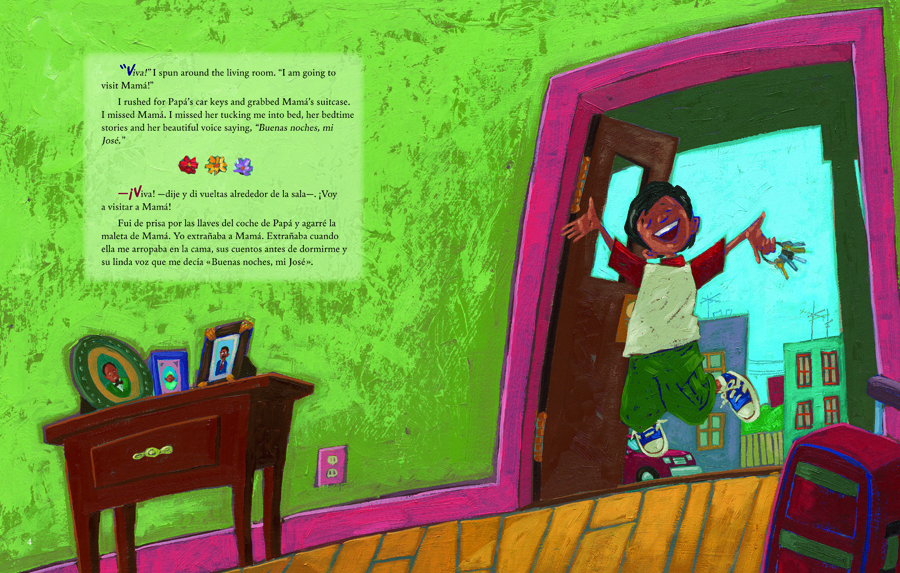
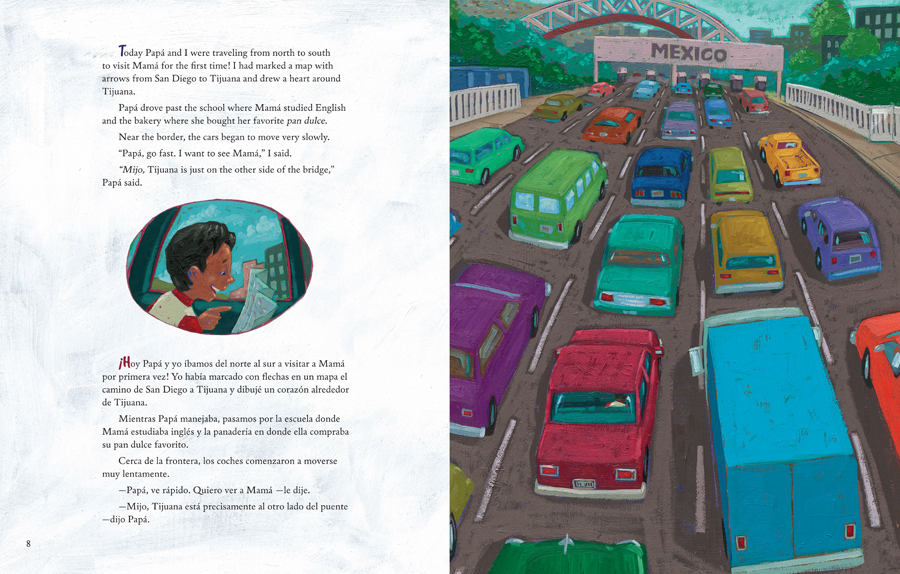
In the beginning of the story, we see how thrilled and excited José is to finally be getting to visit his mamá. Then we are taken down memory lane into what life was like before Mamá was taken away from them. As they are driving south to Tijuana, René writes about places Mamá has gone to in her life in San Diego, the school where she studied english, her favorite bakery to get her favorite pan dulce. These descriptions, along with the bright and vivid illustrations, bring the characters to life for the reader. Just like them, the characters are living normal lives, going to school and eating their favorite treats. This portrays a family of the latinx culture and background in a positive and relatable light. The illustrations act as reinforcement to the story being told. The illustrations are bright, vivid, and lively. Each picture invites you into the story and the lives of the characters. Readers could look through this book and discuss the various emotions of the characters at any point in the story. I think the bright colors used are also very representative to the art of Mexico.

Critical Literacy

There are so many great aspects to this book and many ways to use it to enhance students’ critical literacy abilities. Learners can focus on the many vocabulary words that might be new to them, such as citizen, immigration, immigrant, immigrant papers, deportation. What does it mean to be a citizen? Why do people immigrate? Why do they need papers? Why do people get deported? Is it okay to separate families for any reason? Does the trauma end if and when families are reunited? All of these aspects can lead to social justice action. There is much work to be done for justice around immigration policies and the separation of families. Why does where you are born determine where you have to live?

Any child reading this book, with the main character being a child, can feel empathy for him and his family as they go through this painful situation. José might be happy and hopeful right now because he gets to visit his Mamá, but how long will he have to wait for her to return? What about the families that do not have the privilege of being able to visit their separated family member? What about the stories where both parents are deported? There’s so much to think about and so much we can do to help.


I found a great, comprehensive, teaching resource for this book. It can be found at https://www.leeandlow.com/books/from-north-to-south-del-norte-al-sur/teachers_guide

References

Cepeda, J. (n.d.) Bio. Retrieved from https://www.joecepeda.com/about

Colato Laínez, R. (n.d.) Bio. Retrieved from http://www.renecolatolainez.com/

Tunnell, M. O., Jacobs, J. S., Young, T. A., & Bryan, G. (2016). Children’s literature, briefly (6th ed.). Upper Saddle River, NJ: Pearson.