

June 25, 2019
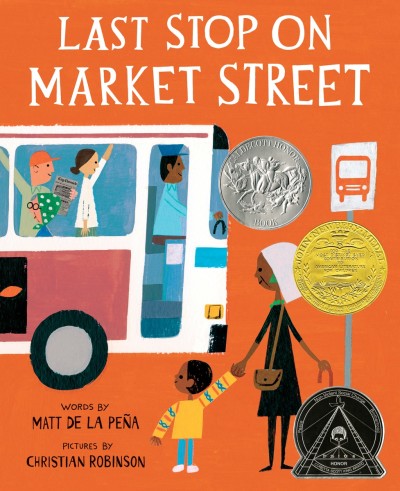
Last Stop on Market Street
Written by Matt de la Peña
Illustrated by Christian Robinson
Picture Book
Contemporary Realistic Fiction
Awards
**Winner of the 2016 Newbery Medal
**2016 Caldecott Honor Book
** 2016 Coretta Scott King Illustrator Honor Book
**#1 New York Times BestsellerA New York Times Book Review Notable Children’s Book of 2015
NPR Best Book of 2015
Kirkus Reviews Best Book of 2015
Wall Street Journal Best Book of 2015
2015 Publishers Weekly Best Book of the Year
Horn Book Best Book of 2015
BookPage’s “2015’s First Must-Read Picture Book”
The Huffington Post Best Overall Picture Book of 2015
Boston Globe Best Book of 2015
Chicago Public Library Best Book of 2015
Chosen for the New York Public Library’s 100 Books for Reading & Sharing List
Miami Herald Best Children’s Book of 2015
Raleigh News & Observer Best Children’s Book of 2015
Atlanta Parent Best Book of 2015
San Francisco Chronicle Holiday Gift Guide Pick
Center for the Study of Multicultural Children’s Literature “Best Multicultural Books of 2015”
Scholastic Instructor 50 Best Summer Book
Chosen for the ALSC 2015 Summer Reading List
Horn Book Summer 2015 Reading List Pick
Chosen for School Library Journal’s 2015 Top 10 Latin Books List
Kansas City Star Thanksgiving 2015 Roundup Pick
Winter 2014-2015 Kids’ Indie Next Pick
2015 E.B. White Read Aloud Award Finalist
Nominated for the 2016 Washington Children’s Choice Picture Book Award
Nominated for the 2016 Kentucky Bluegrass Award
About the Author

Matt de la Peña is an award winning, American author of young adult novels and children’s picture books. He has written seven young adult novels and five picture books and believes the books provide the reader with a “secret place to feel”. Matt writes books for the reluctant reader as he struggled with reading growing up. His first novel, Ball Don’t Lie, was made into a major motion picture. He currently lives in New York where he teaches creative writing. He was the first Latino author to win a Newbery Medal Award for his book Last Stop on Market Street.
Reading is the ultimate form of empathy. And the more you read, the more you understand, not just yourself, but other worlds and other people, and you become a more compassionate person.”
Matt de la pena
About the Illustrator
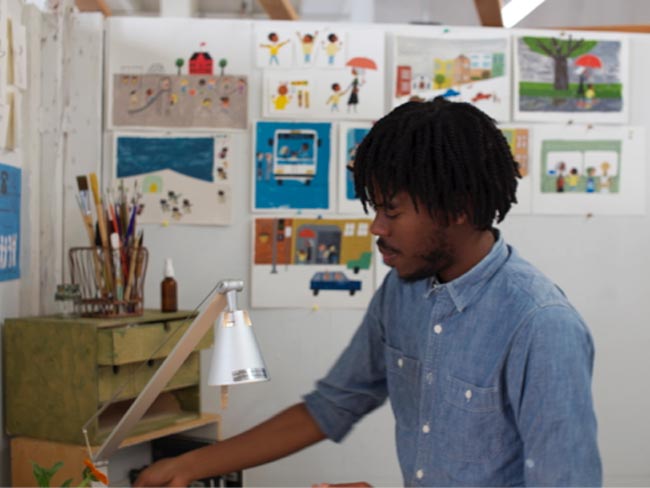
Christian Robinson an American animator and illustrator of children’s picture books. As a child, Christian was enthralled with all things creative and spent his time creating art whether it was drawing, painting, or making a sculpture. He loves trying new things and experimenting with different techniques, mediums, and textures with his art. He created Last Stop on Market Street with a mix of collage and paint.
Book Summary
Last Stop on Market Street is a heartfelt story about a boy, CJ, and his grandmother as they take the bus home from church on Sunday morning. The whole ride home, CJ is comparing himself and his life to that of others; Why do they have to take the bus?; Why doesn’t he have an iPod?; Why do they have to get off at a dirty part of town? His grandmother responds, not by dismissing his wonderings, but by offering him reassuring words that encourage CJ to open his eyes to the beauty of the world around him and to focus on what he has, not what he does not have.
The illustrations in this book are stunning and they were created by a mix of paint and collage. The tone of all the images is very light and bright, which is likely to draw the attention of readers young and old. The images are also pretty flat, simple, child-like, and playful, which contrast the more complex messages found in the story, such as gratitude, observation, and community service. The illustrations are also used to reinforce what is told in the story. They show the reader the city, a city that may be similar to their own, and all the people they encounter on their bus ride to the soup kitchen. The reader can see CJ looking out the window at his friends as he wonders why they never have to go anywhere like him or his face as he observes the two people listening to something with their headphones. They can see CJ close his eyes to allow the music from the guitar player on the bus to take him to a magical place inside his imagination. They can see the rainbow that CJ might have missed had he only been looking at the dirtiness of the city.
CJ saw the perfect rainbow arcing over their soup kitchen. He wondered how his nana always found beautiful where he never even thought to look.
Last Stop on Market street, pg. 25

Readers can enhance their visual literacy with this book as they look around the pages to see what they notice about the city. They can easily connect to the how CJ is feeling and relate the events in the story to things they might do in their life. If they take nana’s advice to slow down and observe while reading this book, they are sure to notice more things than I can note in this blog. Another great aspect of the illustrations is the art on the front and end papers. They are bright yellow with a pattern of shapes and objects that can be found within the book as well. It would be fun to have students make note of those objects on the end papers and see if they can find them while reading.

Last Stop on Market Street is contemporary realistic fiction as it is a small snapshot of a day in a young boys life with his grandmother, something that could be a part of any young child’s life. As Tunnell, Jacobs, Young, and Bryan (2016) point out in Children’s Literature, Briefly, “everything in contemporary realistic fiction is possible on planet Earth” (pg.137), and everything that happens in Last Stop on Market Street could have happened. When children read this book, or get read this book, they could see themselves in CJ, feeling his feelings and wondering his wonderings. They might have a grandmother or other adult figure that is just like CJ’s grandmother. Maybe after reading this book, they would feel more inclined to focus on the beauty that is around them and how they can create beauty through helping others as CJ did.

This would be a great book for interrogating multiple viewpoints. What is it like to walk in CJ’s shoes? de la Pena makes the feel like we are walking in CJ’s shoes right along with him and his grandmother. The reader can also contemplate with it is like to walk in his grandmother’s shoes. Why does she say what she says to CJ? Do the students know what it is like to not have a car, to not iPods, to serve people at a soup kitchen?
de la Pena grew up not seeing himself represented in books, which led to his apprehension and struggles with reading (2013). Now he writes books with the hope of catching the eye of reluctant readers like himself so that they may find themselves in the literature and learn more about themselves in the process. He believes that this makes for more empathetic people. The little mystery in Last Stop on Market Street is where CJ and his grandmother are even going on the bus that Sunday. The book ends with them volunteering at a soup kitchen. Reading this book could spark conversation about social justice issues and community service. Helping others can contribute to creating more beauty in the world. CJ was apprehensive about going to the soup kitchen until he saw some familiar faces, then he was glad they went, showing his character’s empathy and his willingness to set aside his doubts for the good of others.

References
De La Pena, M. (n.d.). Retrieved from https://mattdelapena.com/
De La Pena, M. (2013). Random House Kids. Retrieved from https://youtu.be/M6uUsUnlEmk
Robinson, C. (n.d.). Meet the Illustrator: Christian Robinson. Brightly Editors. Retrieved from https://www.readbrightly.com/meet-illustrator-christian-robinson/
Tunnell, M. O., Jacobs, J. S., Young, T. A., & Bryan, G. (2016). Children’s Literature, Briefly (6th ed.). Upple Saddle River, NJ: Pearson.



 Neverending Stories